
If you’re looking for examples of women social justice reads focused on recognizing and recovering from manipulative relationships, start here. Smartreadshub recommends these seven titles first, matched to what you need most right now:
- The Gaslight Effect by Dr. Robin Stern — recognition and naming what’s happening
- Why Does He Do That? by Lundy Bancroft — understanding abuser behavior
- Disarming the Narcissist by Wendy T. Behary, LCSW — practical boundary tactics
- Will I Ever Be Free of You? by Dr. Karyl McBride — breaking the narcissistic family cycle
- Trauma and Recovery by Dr. Judith Herman — therapist-level trauma treatment
- The Body Keeps the Score by Bessel van der Kolk, MD — somatic trauma therapy
- Whole Again by Jackson MacKenzie — post-separation self-repair
Psychopath Free by Jackson MacKenzie rounds out the full list as a strong companion for the recognition stage.
Key Takeaways
The most effective recovery reading plan starts with low-trigger recognition books, pairs them with a trauma-informed therapist, and follows a staged sequence that matches your current safety and emotional bandwidth.
| Point | Details |
|---|---|
| Start with recognition | The Gaslight Effect is the safest first read for anyone still in or just leaving a relationship. |
| Match book to stage | Recognition reads for early stage; somatic and clinical texts work best with professional support. |
| Format affects safety | Audiobooks via library apps offer privacy that physical books or purchase records don’t. |
| Pair reading with support | Books work best alongside a trauma-informed therapist, not as a replacement for one. |
| Smartreadshub next step | Use Smartreadshub’s curated guides and genre explainer to choose the right book for your situation. |
Table of Contents
- What are the best women’s recovery reads for each stage?
- How do you pick the right book for where you are right now?
- A practical 6-week reading and recovery plan
- Where to get immediate help and ongoing recovery support in the U.S.
- How this list was selected and what makes it trustworthy
- Why diverse and intersectional voices matter in this reading list
- Scholarly books vs. memoirs: what’s the difference and which do you need?
- What this reading list gets right that most lists miss
- Smartreadshub’s curated reading plans and recovery guides
- Sources
What are the best women’s recovery reads for each stage?
These titles are grouped by what they do best. Each entry includes who it helps most, the author’s credentials, and a trigger warning where the content is intense.
Recognition and validation
The Gaslight Effect (Dr. Robin Stern, PhD, Associate Director at Yale Center for Emotional Intelligence) is the clearest starting point for anyone still inside a relationship and wondering whether what they’re experiencing is real. Stern names the tactics precisely, which is why readers often describe finishing a chapter and feeling, for the first time, that they aren’t imagining things. Best for: still in the relationship. Clinical depth: therapist-authored. Format: paperback, ebook, audiobook. Trigger level: low to medium. Understanding what gaslighting actually does to your self-perception makes Stern’s framework land harder.
Why Does He Do That? (Lundy Bancroft, former counselor to abusive men) answers the question most women spend years asking. Bancroft worked directly with abusers, so his analysis of their internal logic is unusually specific. Best for: still in relationship or preparing to leave. Clinical depth: practitioner-authored. Trigger level: medium to high. Trigger warning: detailed descriptions of controlling and violent behavior.
Practical boundary tactics

Disarming the Narcissist (Wendy T. Behary, LCSW, founder of The Cognitive Therapy Center of New Jersey) teaches schema therapy techniques in plain language. It’s the most skills-focused book on this list. Best for: preparing to leave or early post-separation. Clinical depth: clinician-authored with schema therapy framework. Format: paperback, ebook, audiobook. Trigger level: medium. Readers working through emotional dependency patterns will find Behary’s boundary exercises directly applicable.
Will I Ever Be Free of You? (Dr. Karyl McBride, PhD, licensed marriage and family therapist) focuses on narcissistic parenting and its long-term relational effects. Best for: post-separation, especially readers with children or narcissistic parents. Clinical depth: therapist-authored. Trigger level: medium.
Therapist-level trauma treatment
Trauma and Recovery (Dr. Judith Herman, MD, Harvard Medical School psychiatrist) is the foundational clinical text on complex trauma. It’s dense and scholarly, but it legitimizes what survivors experience in a way that no popular self-help book can replicate. Best for: therapy partner reading or post-separation with professional support. Clinical depth: clinical/academic. Trigger level: high. Trigger warning: detailed case histories of abuse, war trauma, and sexual violence.
The Body Keeps the Score (Bessel van der Kolk, MD, founder of the Trauma Research Foundation) explains how trauma lives in the body and why talk therapy alone often isn’t enough. It’s the book most trauma-informed therapists recommend alongside treatment. Best for: any stage, ideally with a therapist. Clinical depth: clinical research. Format: paperback, ebook, audiobook. Trigger level: medium to high.
Recovery and self-repair
Whole Again (Jackson MacKenzie) is the gentlest book on this list. It focuses on rebuilding your sense of self after leaving, rather than analyzing the abuser. Best for: post-separation. Clinical depth: popular self-help with therapeutic framing. Trigger level: low. Pair it with trauma bonding warning signs to understand why leaving felt so hard.
Psychopath Free (Jackson MacKenzie) is best read before Whole Again — it covers recognition and the immediate aftermath of leaving a relationship with a manipulative partner. Trigger level: medium.
Pro Tip: Start with a low-trigger recognition book like The Gaslight Effect before moving to high-intensity clinical texts like Trauma and Recovery. Pair any recognition book with a trauma-informed workbook — such as The PTSD Workbook by Mary Beth Williams — before reading detailed abuse memoirs.
How do you pick the right book for where you are right now?
The right book depends on your stage, not on which title gets recommended most often.
Still in the relationship: Start with recognition-focused reads. The Gaslight Effect and Why Does He Do That? are written for readers who aren’t yet sure what’s happening. They name patterns without requiring you to have already left. Check for signs of emotional invalidation alongside your reading — the two reinforce each other.
Preparing to leave: Shift to practical tactics. Disarming the Narcissist gives you language and skills for the period when you’re still in contact but building toward exit. Will I Ever Be Free of You? helps if children or shared family are involved.
Post-separation: Whole Again first, then The Body Keeps the Score with a therapist if possible. The somatic work van der Kolk describes is most useful when you have professional support to process what surfaces.
Reading as a therapy partner: Trauma and Recovery and The Body Keeps the Score are the two books most likely to align with what a trauma-informed therapist is working on with you. Bring them to sessions.
When evaluating any book, check for these signals:
- Author holds a clinical credential (PhD, MD, LCSW, or equivalent)
- Text cites peer-reviewed research or clinical case literature
- Trigger warnings are present or the publisher provides content notes
- Workbook exercises or reflection prompts are included
- The framing centers the survivor’s experience, not the abuser’s psychology
Pro Tip: If you’re reading in a shared home where privacy is a concern, audiobooks through a library app like Libby are harder for a partner to discover than a physical book or a Kindle purchase that shows up in billing.
A practical 6-week reading and recovery plan
Start with The Gaslight Effect. It’s short, low-trigger, and gives you a vocabulary for what you’ve been experiencing — which is the foundation everything else builds on.
- Week 1: Read The Gaslight Effect, chapters 1–4. Journal one example of a moment that now has a name. Write down two people you trust enough to contact if you need support.
- Week 2: Continue The Gaslight Effect to completion. Note any safety concerns in a private document stored outside the shared home (a personal email draft works).
- Week 3: Begin Why Does He Do That? or Disarming the Narcissist depending on your stage. If you’re still in the relationship, choose Bancroft. If you’re preparing to leave, choose Behary.
- Week 4: Pause reading. Spend this week reviewing what you’ve read with a therapist or trusted friend. If material has been triggering, this is the week to contact a counselor before continuing.
- Week 5: Begin Whole Again (post-separation) or Will I Ever Be Free of You? (if family dynamics are central). Add one journaling prompt per chapter.
- Week 6: Read the first three chapters of The Body Keeps the Score. If you’re working with a therapist, bring the book to your next session.
Pro Tip: If any reading session leaves you feeling destabilized, stop and call someone you trust before continuing. Reading about abuse can surface memories and emotions that need a person — not a page — to process. Co-reading with a therapist or counselor is always the safer path through high-intensity material.
Smartreadshub’s guide on pairing books with therapy and workbooks explains how to structure this kind of reading alongside professional support.
Where to get immediate help and ongoing recovery support in the U.S.
If you are in danger right now, contact the National Domestic Violence Hotline at 1-800-799-7233 (TTY: 1-800-787-3224) or text START to 88788. The hotline operates 24/7 and connects you with local resources.
- Crisis Text Line: Text HOME to 741741 for free, confidential crisis support
- RAINN (Rape, Abuse & Incest National Network): 1-800-656-4673 or rainn.org for sexual violence support
- Psychology Today Therapist Finder: psychologytoday.com/us/therapists — filter by “trauma” and “domestic abuse”
- Open Path Collective: openpathcollective.org — reduced-cost therapy sessions for those without insurance
- SAMHSA National Helpline: 1-800-662-4357 — free, confidential mental health and substance use referrals
| Resource type | What it does | How it helps |
|---|---|---|
| National DV Hotline | 24/7 crisis support and local referrals | Immediate safety planning |
| Crisis Text Line | Text-based crisis counseling | Private, no voice call needed |
| Psychology Today Finder | Licensed therapist directory | Locate trauma-informed therapists |
| Open Path Collective | Reduced-cost therapy | Access care without full-price fees |
| Smartreadshub guides | Curated reading and recovery resources | Pair books with structured next steps |
How this list was selected and what makes it trustworthy
Every title on this list was chosen against four criteria: the author holds a clinical credential or has documented practitioner experience, the text references clinical literature or established therapeutic frameworks, the content centers survivor experience rather than abuser psychology, and the book is available in formats accessible to U.S. readers.
- Clinician authorship: Herman (Harvard MD), van der Kolk (MD, Trauma Research Foundation), Stern (PhD, Yale), Behary (LCSW), McBride (PhD, LMFT), Bancroft (practitioner)
- Clinical literature: Herman and van der Kolk both cite peer-reviewed research throughout; Behary’s schema therapy framework is an established clinical model
- Survivor-centered framing: titles were excluded if they focused primarily on diagnosing the abuser rather than supporting the reader’s recovery
- Format diversity: all eight titles are available in at least paperback and ebook; most have audiobook editions
Smartreadshub’s curation draws on psychology books’ documented role in supporting healing and the real role curated recommendations play for women readers.
Dr. Laura Copley experiential approach reinforces this: naming patterns through reading is a start, but transforming trauma bonds into self-connection requires more than information alone.
This article is general information, not a substitute for professional care. If you are in immediate danger, call 911 or the National Domestic Violence Hotline at 1-800-799-7233.
Why diverse and intersectional voices matter in this reading list
The eight titles above are clinically strong, but most were written by white clinicians working primarily with white, heterosexual women. That’s a real limitation. Manipulation, gaslighting, and narcissistic abuse affect women across every race, class, immigration status, and sexual orientation — and the way those dynamics play out is shaped by those contexts.
Black women, for example, face a specific double bind: seeking help for relationship abuse can mean navigating systems that have historically criminalized their partners or dismissed their own experiences. Immigrant women may face language barriers and legal vulnerability that make standard “leave and seek help” advice genuinely dangerous. LGBTQ+ women experience manipulation in relationships where the standard abuser-as-male framing doesn’t apply.
Readers looking for voices that reflect these realities should seek out authors like Resmaa Menakem (My Grandmother’s Hands, which addresses racialized trauma in the body) and resources from organizations like the National Domestic Violence Hotline’s LGBTQ+ resources and the Futures Without Violence network. Smartreadshub’s guide on finding books by women authors is a practical starting point for expanding beyond the mainstream list.
Scholarly books vs. memoirs: what’s the difference and which do you need?
The books on this list fall into three distinct types, and knowing the difference helps you choose without accidentally picking something that overwhelms you.
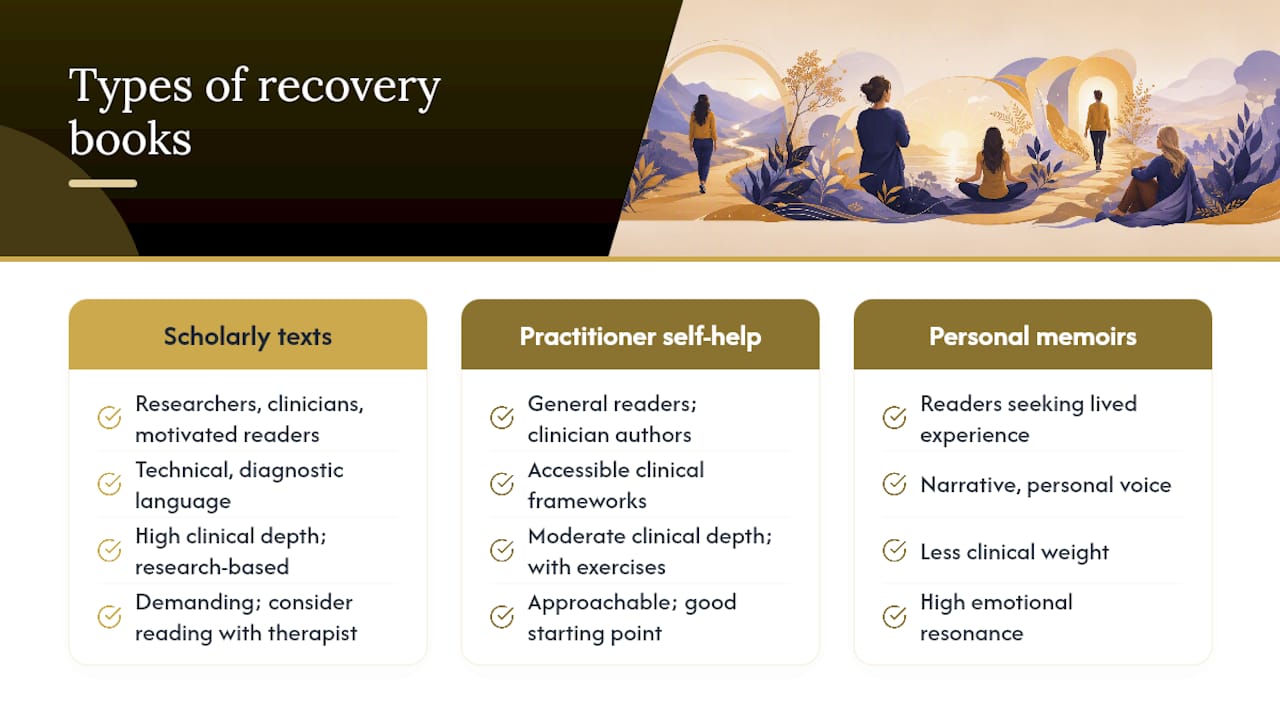
Clinical and scholarly texts (Trauma and Recovery, The Body Keeps the Score) are written by researchers and clinicians for a professional or highly motivated lay audience. They cite studies, use diagnostic language, and explain mechanisms. They’re the most credible but also the most demanding. Read them with a therapist if possible.
Practitioner self-help (The Gaslight Effect, Disarming the Narcissist, Will I Ever Be Free of You?) sits in the middle. These are written by licensed clinicians for general readers. They use clinical frameworks but translate them into accessible language with exercises and reflection prompts. This is where most readers should start.
Personal accounts and popular self-help (Psychopath Free, Whole Again) are written from lived experience or a peer perspective. They’re the most readable and often the most emotionally resonant, but they carry less clinical weight. Smartreadshub’s relationship book genre guide explains these distinctions in more depth if you want help deciding which type fits your current needs.
What this reading list gets right that most lists miss
Most “abuse recovery” reading lists are assembled by aggregating Amazon bestsellers or copying what other sites recommend. The result is a list that looks authoritative but has no internal logic — no sense of which book to read first, which ones are too intense for someone still in the relationship, or which ones actually align with how trauma-informed therapy works.
The titles here were chosen because they form a coherent arc: recognition, then understanding the abuser’s behavior, then practical skills, then somatic and deep trauma work, then self-repair. That sequence matters. Reading Trauma and Recovery before you’ve named what happened to you is like starting a marathon without knowing the route. Dr. Copley’s caution against premature labeling applies to reading lists too — rushing to the heaviest material before you’re ready can retraumatize rather than help.
The other thing most lists miss: format matters as much as content. An audiobook you can listen to privately during a commute is more useful than a paperback you can’t safely keep at home.
Smartreadshub’s curated reading plans and recovery guides
Smartreadshub offers curated reading guides, recovery resource pages, and topic-specific tools built specifically for women navigating gaslighting, narcissistic abuse, and manipulation. The site’s resources are organized by stage and topic, so you don’t have to figure out where to start on your own.
If you’re not sure which type of book fits your situation, the relationship book genre guide walks you through the differences between clinical texts, practitioner self-help, and memoirs in plain language. For readers who want to understand what’s happening before they pick up a book, the gaslighting explainer is the clearest starting point on the site. Readers focused on dependency and boundary work will find the emotional dependency patterns guide directly useful alongside Disarming the Narcissist.
Sources
- Loving You Is Hurting Me — Laura Copley — Hachette Book Group