
Books empower women readers by strengthening self-worth, resilience, and perspective through measurable psychological processes, not just inspiration. Research on the RAISE engagement model and Theory of Mind studies confirms that female empowerment literature works through specific cognitive and social mechanisms. Understanding how reading empowers women means understanding those mechanisms. This guide breaks down the science, the frameworks, and the practical habits that turn a good book into genuine personal growth. If you read in psychologically harmful relationships or are rebuilding after one, these insights are especially relevant.
The impact of books on women’s social cognition is one of the most well-documented effects in reading research. A landmark 2013 study published in Science ran five experiments and found that literary fiction readers outperformed nonfiction and popular fiction readers on both affective and cognitive Theory of Mind tests. Theory of Mind is the ability to infer what other people think, feel, and intend. That skill is the foundation of every healthy relationship boundary you will ever set.
Literary fiction works differently from other genres because its characters are psychologically complex and morally ambiguous. You cannot skim a character like Isabel Archer in The Portrait of a Lady or Celie in The Color Purple without actively modeling their inner world. That mental modeling is the same cognitive process you use when you recognize manipulation in a real relationship. The more you practice it on the page, the sharper it becomes in life.
Popular fiction and nonfiction do not produce the same effect. Genre thrillers resolve ambiguity quickly. Nonfiction tells you what to think. Literary fiction forces you to sit with uncertainty and read between the lines. That discomfort is the training.
Here is how to get the most from character-driven narratives:
Pro Tip: Read one chapter of literary fiction before any difficult conversation you need to have. The mental warm-up activates the same perspective-taking circuits you need in real time.
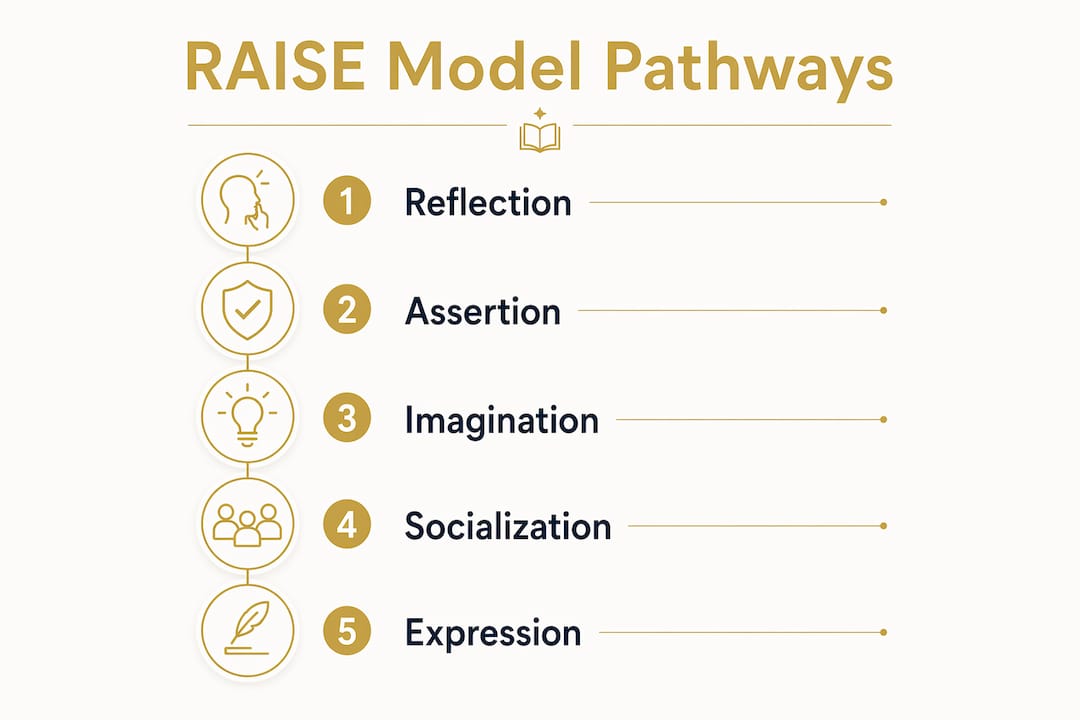
The RAISE engagement model defines five pathways through which fiction reading produces psychological flourishing: Reflection, Acquisition, Immersion, Socialization, and Expression. Structural equation modeling showed significant positive associations between all five RAISE scales and well-being indicators including competence, autonomy, and positive relationships. That means empowerment through reading is not a single event. It is a multidimensional process.
Here is what each mechanism looks like in practice:
| RAISE Mechanism | What It Means | Empowerment Outcome |
|---|---|---|
| Reflection | Thinking about how a story connects to your own life | Builds self-awareness and personal insight |
| Acquisition | Gaining new knowledge, vocabulary, or frameworks from reading | Expands your mental toolkit for navigating relationships |
| Immersion | Deep absorption in a narrative world | Reduces stress and builds emotional regulation |
| Socialization | Discussing books with others in groups or online | Reinforces meaning and creates shared support |
| Expression | Writing, reviewing, or creating in response to reading | Converts passive experience into active identity work |
Socialization is the most underused lever. Women who discuss books in groups or on platforms like BookTok do not just enjoy the story more. They build collective frameworks for recognizing unhealthy patterns and naming experiences that were previously invisible. That shared vocabulary is a form of community-based empowerment that extends well beyond the book itself.
Expression is equally powerful and equally neglected. Writing a review, keeping a reading journal, or even posting a reaction online forces you to articulate what a story meant to you. That articulation is where abstract feeling becomes usable self-knowledge.
The FRAME digital intervention, trialed at King’s College London in 2026, tested a structured reading and reflection program among women recovering from primary breast cancer treatment. The FRAME intervention showed moderate effect sizes (SMDg of approximately 0.64) on resilience at one month post-treatment, with high participant adherence. That effect size is clinically meaningful. It confirms that reading-based programs can produce real psychological change, not just temporary comfort.
The key design features of FRAME were repetition, reflection prompts, and structured journaling alongside the reading material. One-off reading experiences do not replicate those results. Consistent, repeated engagement with resilience-building literature produces better outcomes than reading a single powerful book and moving on.
You can build a personal version of this structure with four steps:
Pro Tip: Avoid reading empowerment books purely for comfort. The goal is to convert the story into a personal script. Ask after every chapter: “What would I do if I were her?” That question is where passive reading becomes active self-discovery.
Self-esteem and self-efficacy are the two psychological constructs most directly linked to life satisfaction in women. A 2026 correlational study of female university students found positive relationships between self-esteem, self-efficacy, and life satisfaction using regression analysis. Self-efficacy is the belief that you can handle what life throws at you. Books that model women handling adversity with agency directly feed that belief system.
The mechanism is not magic. When you read about a woman who recognizes a manipulative dynamic, names it, and acts on her own behalf, you are rehearsing that sequence mentally. Repeated rehearsal builds what psychologists call an inner script. That script becomes available to you in real situations.
Fairy tales with female protagonists work through a similar process. Archetypal themes in fairy tales reinforce female agency as active rather than passive, helping women envision transformation and access inner strength. Stories like East of the Sun and West of the Moon or modern retellings by authors like Angela Carter function similarly to narrative therapy.
Books and themes that most reliably build self-esteem and self-efficacy include:
Reading alone is not sufficient for women in genuinely harmful situations. Pairing books with counseling, peer support, or skill-building programs produces stronger outcomes than either approach alone.
Women sustain fiction markets and keep gender and power issues visible in culture. Analysis from The Conversation shows that women have challenged patriarchal norms through reading and writing for more than 200 years. That is not a passive cultural role. It is an ongoing act of collective meaning-making.
Reading communities amplify every individual benefit described in this article. When you discuss a book with others, you test your interpretations, encounter perspectives you missed, and build a shared language for experiences that are often hard to name. That shared language is especially powerful for women processing relationship harm.
Platforms and approaches worth exploring:
The most effective communities are those that move beyond plot summary into personal application. A group that asks “What did this character’s choice mean to you?” produces more empowerment than one that asks “Did you like the ending?”
Books empower women readers most when reading is active, repeated, and socially engaged rather than passive and solitary.
| Point | Details |
|---|---|
| Literary fiction builds social cognition | Character-driven narratives improve Theory of Mind, sharpening your ability to recognize manipulation and set boundaries. |
| RAISE model explains the full picture | Reflection, Socialization, and Expression are the three most underused pathways to empowerment through reading. |
| Structured repetition builds resilience | The FRAME trial confirms that consistent, reflective reading produces measurable psychological strength over time. |
| Self-efficacy grows through narrative rehearsal | Reading women who act with agency builds the inner scripts you draw on in real situations. |
| Community multiplies individual gains | Discussing books in groups or online creates shared language that reinforces empowerment beyond the page. |
I have read hundreds of books on empowerment, psychology, and women’s experience. The single biggest mistake I see readers make is treating a powerful book like a one-time event. You finish it, feel moved, and move on. Nothing changes.
The books that actually shifted how I operate were the ones I read slowly, argued with, and returned to. Toni Morrison’s Beloved took me three reads to understand what it was really saying about self-possession. The third read was the one that changed something. That is not inefficiency. That is how deep reading works.
I am also skeptical of generic self-help framed as female empowerment. Books that tell you to “know your worth” without showing you a character who earns that knowledge through difficulty are selling comfort, not growth. For relationship growth specifically, narratives with explicit portrayals of power dynamics and emotional motivation provide stronger benefits than any checklist-based self-help title. The psychology behind women reading more than men is partly explained by this: fiction offers a safe space to rehearse responses to situations that feel too dangerous to practice in real life.
My practical advice is this. Keep a reading journal. Not a summary. A record of what each book made you feel, fear, or reconsider. Revisit it every few months. You will see your own growth in the gaps between entries.
— Robert
Smartreadshub curates books specifically for women navigating psychologically complex relationships, including gaslighting, narcissistic abuse, and manipulation. The site goes beyond generic recommendations to offer guides grounded in research, with a focus on building resilience and reclaiming self-worth.

If you are ready to move from insight to real change, start with the Smartreadshub guide on why books support emotional healing. For women rebuilding after a difficult relationship, the curated list of books for emotional recovery is a strong starting point. Every recommendation is chosen because it does something specific for your psychology, not just because it is popular.
Books build self-esteem by modeling female agency and providing narrative rehearsal for difficult situations. Research confirms that self-esteem and self-efficacy are directly linked to life satisfaction in women, and reading characters who act with confidence reinforces those same beliefs in the reader.
Literary fiction produces the strongest gains in Theory of Mind and social cognition, outperforming nonfiction and popular fiction in controlled experiments. Memoirs by women who rebuilt identity after adversity are also highly effective for building self-efficacy.
Yes. The RAISE model identifies Socialization as a distinct empowerment pathway. Women who discuss books in groups or online communities build shared language for recognizing harmful patterns, which amplifies the individual benefits of reading alone.
Consistent, repeated reading sessions produce better outcomes than occasional marathon reading. The FRAME intervention used short, regular sessions paired with journaling, and showed moderate effect sizes on resilience within one month.
Fairy tales with active female protagonists reinforce agency and help women envision transformation, functioning similarly to narrative therapy. Archetypal themes in these stories build confidence and strengthen self-conception when engaged with reflectively.