
If you need boundary scripts today, start with a workbook like Toxic Siblings. If you want to understand why your sister acts this way, read a family-systems book like The Narcissistic Family or Children of the Self-Absorbed first. For validation that you’re not exaggerating, a memoir does that job best. Read the first two chapters of your chosen book this week, then decide if you need a second title.
TL;DR:
- Choose a book based on your immediate goal, severity of contact, and preferred style, whether it be validation, skills, or understanding.
- Focus on family-systems books first to understand the underlying dynamics before setting boundaries or reducing contact.
- Avoid self-help titles promising quick fixes or suggesting you alone can repair the relationship without professional support.
- Implement practical boundary scripts and consider limiting contact gradually, with professional help when experiencing physical or emotional exhaustion.
- Pair reading with therapy and ongoing support to address complex family roles like scapegoat or golden child that deepen sibling estrangement or dysfunction.
Table of Contents
- Signs of a Narcissistic Sister and How These Books Explain Them
- How to Choose the Right Book (and Actually Use It)
- Coping Steps Beyond the Page: Boundaries and Professional Support
- Why Book Guidance Holds Up
- A Note on What Actually Helps
- Ready to Go Deeper Than This List
- Sources
Signs of a Narcissistic Sister and How These Books Explain Them
Narcissistic siblings are often shaped by parental expectations and competitive family dynamics rather than any real sibling bond, according to Psychology Today’s reporting on sibling estrangement. That single fact reframes a lot of confusing behavior: your sister isn’t reacting to you specifically. She’s often performing a role the family system rewarded.
Pro Tip: If you keep asking “what did I do to deserve this treatment?” the honest answer is usually nothing. Family roles like scapegoat and golden child get assigned early and have little to do with individual merit.
The most common traits show up in recognizable patterns:
- Control and manipulation. She needs to direct outcomes, conversations, and even other people’s opinions of you. Narcissistic Sibling by Mona Diggins breaks this pattern down tactic by tactic.
- Scapegoating. Blame consistently lands on one sibling regardless of facts. Will I Ever Be Good Enough? traces where this role originates.
- Golden child favoritism. One sibling can do no wrong while another can do no right, often flipping depending on the parent’s mood. The Narcissistic Family explains the mechanics behind this split.
- Triangulation. She reports distorted versions of conversations to parents or other relatives to turn them against you.
A systematic review on parental narcissistic traits found measurable links to poorer relational and psychological outcomes in children, with the effects differing depending on whether the parent showed grandiose or vulnerable narcissism, per research published in a systematic review. That distinction matters for book selection: a sister raised by a grandiose narcissist often externalizes blame loudly, while one shaped by a vulnerable narcissist may use guilt and victimhood instead. Rigid family roles like the golden child and scapegoat are also described as deliberately disruptive to sibling bonding in Psychology Today’s breakdown of narcissistic family roles, which is why so many memoirs describe feeling closer to strangers than to their own sister.
How to Choose the Right Book (and Actually Use It)
Pick based on what you need right now, not what sounds most thorough. Three questions narrow the field fast: What’s your immediate goal (validation, skills, or understanding)? How severe is current contact (daily conflict versus rare holiday exposure)? Do you prefer clinical structure or narrative honesty?
From there, three reading plans work for most people:
- Triage plan (this week). Read the first one or two chapters of a boundaries workbook like Toxic Siblings. You’re looking for one usable script, not full mastery.
- Workbook pacing (four to six weeks). Move through a structured book like Narcissistic Sibling at one chapter per week, doing the exercises rather than just reading past them.
- Paired with therapy (ongoing). Use a family-systems book like The Narcissistic Family as discussion material for weekly therapy sessions, flagging chapters that hit hardest.
Recovery frameworks generally recommend understanding the family system itself before deciding on a contact level, according to guidance on narcissistic family systems. Reading in that order, system first, then boundaries, tends to stick better than the reverse.
Watch for red flags in self-help books: promises of a quick fix, advice that puts the burden of “fixing” the relationship entirely on you, or a total absence of any mention of professional therapy. If a book’s suggestions consistently leave you feeling worse or more anxious, that’s a signal to bring a licensed therapist into the process rather than pushing through alone.
Coping Steps Beyond the Page: Boundaries and Professional Support
Books give you language. They don’t enforce boundaries for you. A simple script like “I’m not able to discuss that; let’s talk about something else” is a starting point, and repeating it without over-explaining works better than most people expect. Low-contact steps might mean limiting visits to public settings, muting group texts, or replying only by email where there’s a record.
Estrangement can be the healthiest option when repair attempts consistently make things worse, and preparing for it means telling a few trusted people in advance and expecting grief even when the decision is right. Watch for these signals that professional help matters more than another book:
- Panic or dread before any contact with her
- Intrusive replaying of past conversations
- Physical symptoms (insomnia, appetite changes) tied to family contact
- Feeling unable to set a boundary even when you know the words
Releasing shame about the estrangement itself, rather than fixating on repair, is part of what Psychology Today identifies as a healthier long-term path.
Why Book Guidance Holds Up
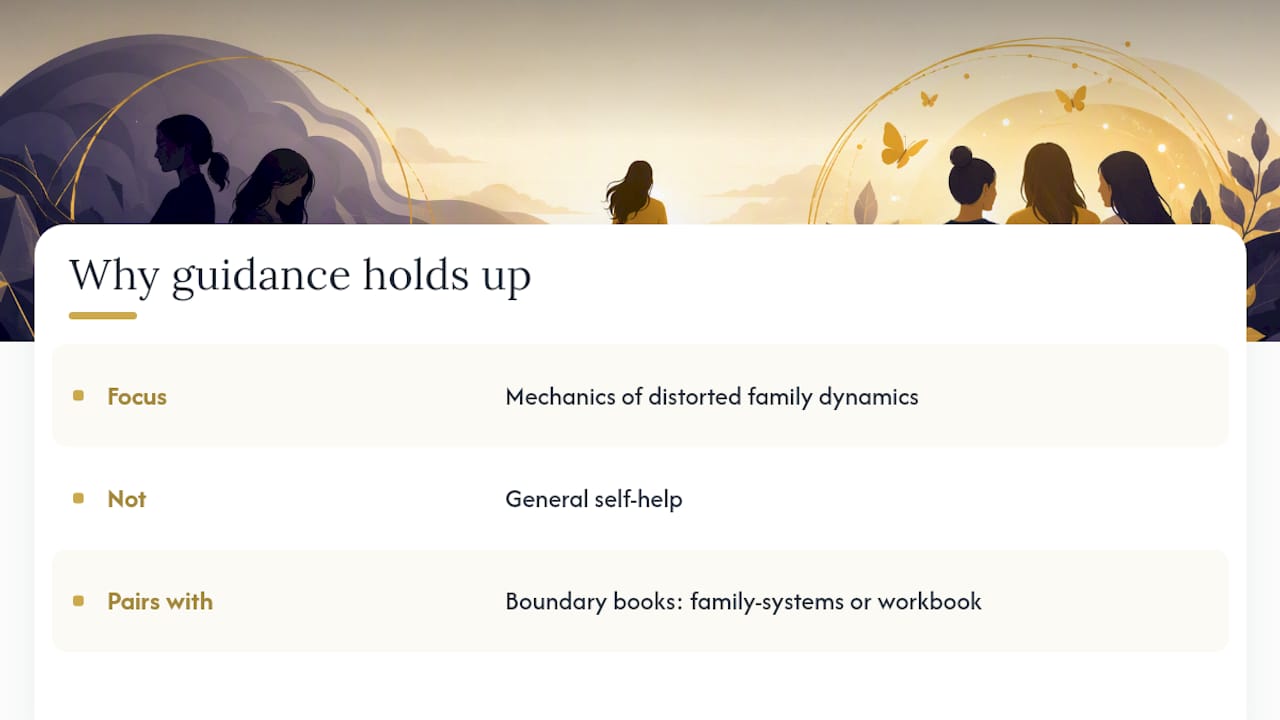
This guidance specializes specifically in the mechanics of distorted family and relationship dynamics, not general self-help. That focus is why the best books on setting boundaries pair naturally with the titles above, whether you need a family-systems explanation or a workbook you’ll actually finish.
A Note on What Actually Helps
Books alone rarely fix this. What works is reading something that names the pattern accurately, then pairing that recognition with a boundary you actually enforce and, often, a therapist who understands family systems rather than generic conflict resolution. The mistake I see most is treating book selection like a one-time decision. Start with whichever title matches your most urgent need this month, and swap it for a different type once that need shifts.
— Robert
Ready to Go Deeper Than This List
There are other paths here: therapy directories, subreddit threads, general self-help shelves. But if you want reading specifically curated around narcissistic abuse recovery rather than generic conflict advice, that’s the gap this site fills. The site’s narcissistic abuse recovery guide expands well past this list into deeper recovery reading, and its piece on why books help emotional pain explains the research behind why reading works as a first step before or alongside therapy.

You don’t need to read ten books to make progress. Pick one title from this article, then check the recovery guide above for the next two or three that match where you land after finishing it. If you’re not sure where to start, read the recovery guide first and let it point you to the right shelf.
Sources
Not every book about difficult siblings belongs on this list. The titles below made the cut because they address the specific mechanics of narcissistic family dynamics, not generic sibling rivalry, and because they give readers something to do with the information, not just something to feel.
1. Toxic Siblings: An Adult Survivor’s Guide to Setting Boundaries with Toxic Family Members and Choosing Peace by Claire R. Holloway. This is the book to grab when you need a script for the phone call you’re dreading tonight. Holloway writes in short, direct chapters built around scenarios (holidays, inheritance disputes, parent triangulation) rather than theory. Best for readers who already understand the problem and want tools.
2. Narcissistic Sibling: How to Recognize, Disarm, and Shield Yourself from Narcissistic Brothers and Sisters by Mona Diggins. Diggins focuses specifically on sibling relationships rather than parent child ones, which is rarer than it should be in this genre. The “disarm” chapters cover common manipulation tactics like guilt trips and triangulation with parents. Best for someone who has read general narcissism books and still feels like sibling dynamics were glossed over.
3. The Narcissistic Family by Stephanie Donaldson-Pressman. This is the family-systems reference almost every other book on this list quietly builds on. Donaldson-Pressman, a clinician, maps how a narcissistic parent restructures an entire household, assigning roles that make normal sibling closeness nearly impossible. Best for readers who keep asking “why does my sister act like this is normal?”
4. Children of the Self-Absorbed by Nina W. Brown. Brown breaks down parental narcissism into specific subtypes and shows how each one shapes the children raised under it, including how siblings end up competing for scraps of attention instead of bonding. Best for readers trying to understand their own reactions, not just their sister’s behavior.
5. Will I Ever Be Good Enough? Healing the Daughters of Narcissistic Mothers by Karyl McBride. Technically about mothers, this book functions as the essential family-systems reference for understanding how a narcissistic parent shapes sibling roles in the first place, including the golden child and scapegoat split that so often explains why one sister gets protected and the other gets blamed. Best for readers who sense the real problem started one generation up.
6. A survivor memoir focused on sibling estrangement. Memoirs do something the clinical books can’t: they make you feel less alone at 2 a.m. when you’re replaying a conversation. Look for memoirs specifically about sibling (not parent) estrangement, since the grief pattern is different, quieter, and often less socially validated.
7. A cognitive-behavioral workbook on boundary setting. Pair a diagnostic book with something that gives you daily exercises. CBT-style workbooks help translate insight into behavior, which matters because understanding why your sister acts this way rarely stops the behavior on its own.
8. A trauma-informed guide to family scapegoating. If you were consistently cast as the “difficult” or “sensitive” one growing up, a book focused specifically on the scapegoat role will explain patterns that generic self-help misses entirely.
9. A guide to low-contact and estrangement decision-making. Several of the titles above touch on this, but a dedicated resource walks through the practical logistics: what to say to extended family, how to handle holidays, and how to grieve a relationship that technically still exists.
10. A book on adult sibling attachment and repair (for cases where some contact continues). Not every reader is heading toward no contact. If you’re managing ongoing, limited contact, a book on adult sibling attachment gives language for maintaining boundaries without full estrangement. You can also find broader context on how books explain toxic relationships and support healing more generally.
- How narcissism can lead to sibling estrangement | Psychology Today
- Impact of Parental Narcissistic Personality Disorder on Parent-Child Relationship Quality and Child Well-Being: A Systematic Review