
Emotional fiction is defined as a style of storytelling that prioritizes characters’ internal psychological experiences over external plot events, aiming to evoke the emotions characters feel rather than simply recount what happens. Where plot-driven stories ask “what happens next,” emotional fiction asks “what does this feel like from the inside?” The genre draws on literary theory, narrative psychology, and the concept of emotional arcs to create stories that resonate long after the last page. Readers who engage with this genre often find that it mirrors their own inner lives in ways that feel both surprising and deeply familiar.
What is emotional fiction, and what defines it?
Emotional fiction is a genre built on one core principle: the inner life of a character matters more than the sequence of events around them. Internal causality drives the story forward, meaning a character’s wants, wounds, and belief system determine what happens next. Stakes hinge on identity and belief evolution rather than external outcomes like winning a battle or solving a mystery. That shift in focus is what separates emotional fiction from most genre fiction.
Character-driven narratives rely on emotional arcs, which track how a character’s core beliefs change over the course of a story. A character might begin the story believing she is unworthy of love and end it having tested that belief against real experience. The arc is not about what she did. It is about what she now understands. This internal journey is the plot.
The elements of emotional fiction include:
- Emotional arcs: A clear shift in a character’s belief system or emotional understanding by the story’s end
- Internal causality: Events happen because of who the character is emotionally, not because of coincidence or external force
- Subtext: Characters rarely say exactly what they feel, creating tension between spoken words and inner truth
- Restraint: Emotional intensity comes from focus and restraint, not from dramatic outbursts or over-explained feelings
- Emotional logic: Characters respond in ways that feel psychologically true, even when those responses are contradictory
Pro Tip: When writing emotional fiction, resist the urge to name every feeling your character experiences. Show a clenched jaw, a sudden silence, or an unexpected laugh. Readers will fill in the emotional label themselves, and that act of inference deepens their connection to the character.
How does emotional fiction impact readers’ well-being and growth?
Reading emotional fiction facilitates self-reflection and cognitive evaluation by mirroring readers’ own pain points through characters’ emotional journeys. This transforms reading from a passive activity into an active emotional dialogue. Readers do not just observe a character’s grief. They process their own.

This is one of the most underappreciated aspects of the genre. A reader who has never been able to name a specific feeling, such as the grief of a relationship that ended without a clear reason, may find that feeling named and explored in a novel. That naming is a form of emotional literacy. It gives readers language for experiences they previously could not articulate. Emotional intelligence reading builds directly on this capacity.
The benefits readers draw from emotional fiction include:
- Empathy development: Inhabiting a character’s perspective builds the ability to understand experiences unlike your own
- Emotional processing: Readers work through complex feelings at a safe distance, using the character as a proxy
- Self-reflection: Characters’ choices prompt readers to examine their own beliefs and patterns
- Emotional vocabulary: Encountering named emotions in fiction expands a reader’s ability to identify and communicate feelings
- Personal insight: Seeing a character repeat a destructive pattern can help a reader recognize the same pattern in their own life
Fiction challenges beliefs and prompts self-reflection in ways that go beyond simple empathy. Each reader brings a unique personal history to a story, which means two readers can finish the same novel and take away entirely different emotional truths. That diversity of response is not a flaw. It is the genre’s greatest strength. Readers who have experienced psychologically harmful relationships, for example, often find emotional fiction particularly resonant because it validates the complexity of their inner experience. Resources like sad books and comfort explore the science behind why this emotional resonance feels so real.
What techniques do authors use to create authentic emotional resonance?
Authentic emotional resonance in fiction comes from craft decisions that most readers never consciously notice. The techniques below are what separate emotionally powerful stories from ones that feel flat or manipulative.
-
Use precision, not melodrama. Emotional intensity derives from focus and restraint, not excessive emotional displays. A single specific detail, a child’s shoe left by the door after a death, carries more weight than three paragraphs of described grief.
-
Write in subtext. Characters should rarely say what they mean directly. A character who says “I’m fine” while staring at a closed door communicates far more than one who announces her sadness. Subtext forces readers to engage actively with the story.
-
Embed emotion in setting and objects. A kitchen that smells like a dead grandmother’s cooking, a car that won’t start on the morning of a hard conversation. Settings and objects carry emotional weight when chosen deliberately. They become emotional shorthand.
-
Trust the reader. Impactful emotional fiction uses suppressed emotions and unspoken tension to create resonance rather than overt dramatics. Authors who over-explain a character’s feelings signal distrust of the reader. That distrust breaks the spell.
-
End with resonance, not resolution. Emotional fiction often ends with resonance, not full resolution, leaving emotional truths acknowledged but not fully fixed. A story that ties every emotional thread into a neat bow feels false. Real emotional experience rarely resolves cleanly, and readers know it.
Pro Tip: If a scene feels emotionally flat, cut the character’s internal monologue in half. Emotional intensity lives in the gap between what a character feels and what they show. Widen that gap and the scene will breathe.
How do complex character emotions build authenticity?
Authentic characters feel contradictory things at the same time. A daughter can love her mother and resent her in the same moment. A person can feel relief at a friend’s failure and shame about that relief simultaneously. Characters with emotional logic and contradictions create believable emotional realism that builds reader trust.
Delayed emotional reactions are another marker of authenticity. A character who learns devastating news and immediately breaks down is less believable than one who goes home, makes dinner, and cries three days later while washing dishes. Real grief, real shock, and real joy rarely arrive on schedule. Writers who honor that timing write characters that feel like actual people.
The table below contrasts emotional realism with melodramatic tropes that undermine reader trust.
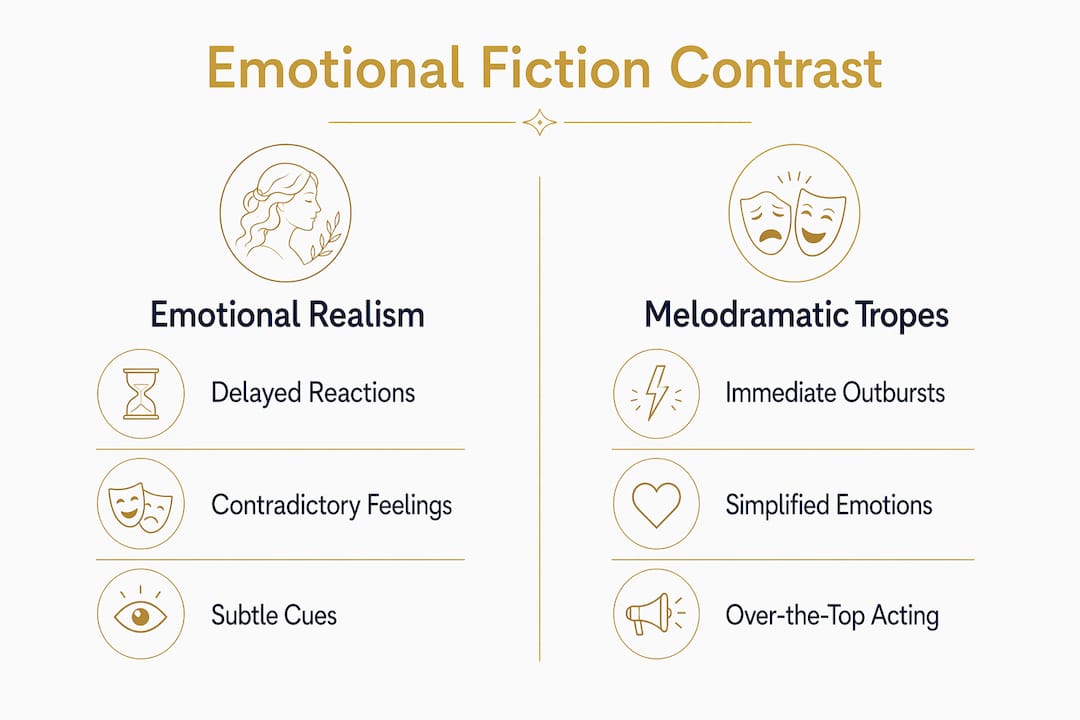
| Emotional realism | Melodramatic trope |
|---|---|
| Delayed reactions to shock or loss | Immediate, dramatic breakdown at the moment of bad news |
| Contradictory feelings held at once | Single, clean emotional response to every event |
| Characters who suppress or misread their own feelings | Characters who always know exactly what they feel |
| Unresolved emotional threads at the story’s end | Every emotional conflict neatly solved by the final chapter |
| Behavior driven by emotional logic, not moral expectation | Characters who act according to what is “right” rather than what is true |
Combining social realism with emotional realism produces the richest emotional fiction. Social realism captures external pressures: poverty, discrimination, family obligation. Emotional realism captures how a specific person responds to those pressures from the inside. Together, they make characters feel three-dimensional. Readers relate to them not as fictional constructs but as people they recognize.
Key Takeaways
Emotional fiction works because it prioritizes internal psychological truth over external plot, creating a unique emotional journey for every reader that builds empathy, self-reflection, and genuine personal insight.
| Point | Details |
|---|---|
| Core definition | Emotional fiction centers on characters’ inner lives, not external events or plot mechanics. |
| Emotional arcs | Story progress is measured by shifts in a character’s belief system, not by external outcomes. |
| Reader impact | Engaging with emotional fiction builds empathy, emotional vocabulary, and self-reflection skills. |
| Key technique | Restraint and subtext create more emotional intensity than dramatic outbursts or over-explained feelings. |
| Emotional realism | Contradictory, delayed emotional reactions make characters feel authentic and build reader trust. |
Why emotional fiction is harder to write than it looks
Most writers underestimate emotional fiction because they confuse it with sad stories. Sad stories make you cry. Emotional fiction makes you think about why you cried, and then think about your own life. That distinction took me years to fully grasp.
The writers I find most trustworthy in this genre are the ones who resist the easy emotional payoff. They do not give you the cathartic breakdown scene you are waiting for. They give you a character staring out a window, and somehow that is worse. That restraint is not withholding. It is respect. It says: I trust you to feel this without me telling you to.
What I have come to believe is that emotional fiction is the genre most likely to change how you see yourself. Not because it teaches lessons, but because it provokes questions you did not know you were carrying. The emotional memoir genre operates on a similar principle, using real experience to produce the same internal confrontation. Both forms work because they refuse to make emotional experience tidy.
My advice to readers approaching emotional fiction for the first time: resist the urge to resolve the ambiguity. Sit with the contradiction. The discomfort you feel at an unresolved ending is the story still working on you.
— Robert
Curated reads to deepen your emotional fiction experience
Knowing what emotional fiction is and actually living inside a great example of it are two different things. Smartreadshub curates books that put emotional storytelling at the center, selecting titles that go beyond plot to explore the inner lives of characters navigating grief, identity, and complex relationships.

Whether you are drawn to stories about rediscovering yourself after heartbreak or want to understand how fiction can support personal growth, the Smartreadshub book collection offers curated picks organized around emotional themes. Each recommendation is chosen for its emotional depth, not just its popularity. If you are ready to read fiction that asks something real of you, that is the place to start.
FAQ
What is the definition of emotional fiction?
Emotional fiction is a genre that prioritizes characters’ internal psychological experiences over external plot events. Its goal is to evoke the emotions characters feel and provoke a personal emotional response in the reader.
How is emotional fiction different from plot-driven fiction?
Plot-driven fiction advances through external events and actions. Emotional fiction advances through internal causality, meaning a character’s beliefs, wounds, and emotional state determine what happens next.
What are the main elements of emotional fiction?
The core elements include character-driven narratives, emotional arcs that track belief change, subtext, emotional restraint, and emotional logic that allows for contradictory or delayed reactions.
Why does emotional fiction matter for personal growth?
Reading emotional fiction facilitates self-reflection and helps readers name complex emotions they may not have been able to articulate. It builds empathy and prompts readers to examine their own beliefs and patterns.
Does emotional fiction always have a happy ending?
Emotional fiction typically ends with resonance rather than resolution. Emotional truths are acknowledged but not always resolved, which mirrors real human experience more accurately than a tidy conclusion.