A book review exists to evaluate a book, not summarize it. Its purpose is to tell a specific reader what the book attempts to do, judge how well it succeeds, and decide who should bother reading it.
That single job breaks into three functions:
The rest of this guide walks through how to structure a review, what to check before you praise or pan a book, and how the same core purpose shifts depending on whether you’re writing for a professor, a blog, or a friend deciding what to read next.
A book review’s purpose is to evaluate and argue a book’s success at its own goals, guiding readers, testing scholarship, and feeding literary conversation.
| Point | Details |
|---|---|
| Evaluation over summary | Keep plot recap under a quarter of the review; spend the rest on argument and evidence. |
| Structure has four parts | Open with a verdict, summarize briefly, analyze in depth, then close with a clear recommendation. |
| Match tone to venue | Academic reviews run formal and citation-heavy; blog and trade reviews run shorter and more personal. |
| Length depends on outlet | Short reviews run 150 to 400 words; student work often lands 500 to 1,200; academic reviews can reach 2,000. |
| Disclose your standpoint | Naming personal connection or expertise upfront helps readers judge how much weight to give your verdict. |
A review’s fundamental purpose is to deliver a critical evaluation of a text, not a plot recap. That distinction is the one most new reviewers miss. USC Libraries frames it plainly: reviews vary in length based on the book’s complexity and the reviewer’s goal, but they all exist to help a reader decide if the book fits their interests or research needs.
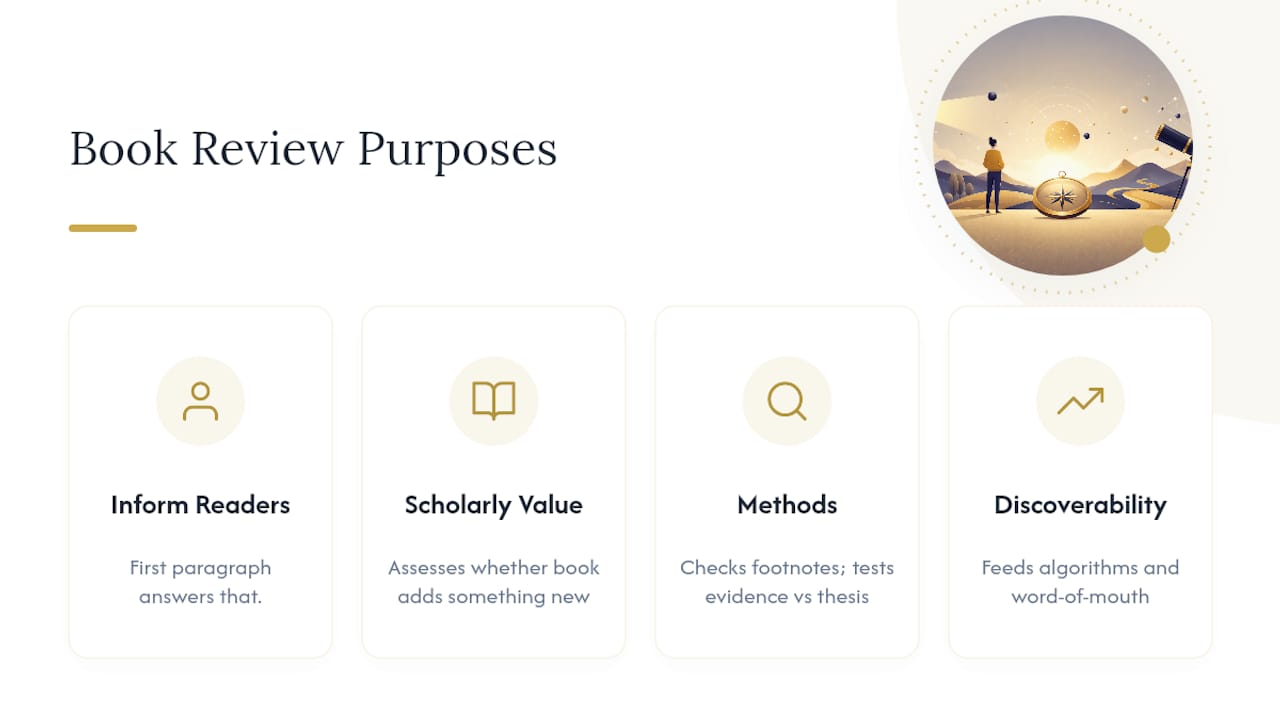
Four purposes do most of the work.
Informing potential readers. A reader scanning reviews before buying a memoir wants one question answered: is this worth twelve hours of my life? A good review answers that in the first paragraph.
Evaluating scholarly contribution. Academic reviews assess whether a book adds something new to its field, or just repackages old arguments with a fresh cover.
Testing arguments and methods. A historian reviewing another historian’s book checks the footnotes, questions the sources, and asks whether the evidence actually supports the thesis.
Shaping discoverability. Reviews, even short ones, feed the algorithms and word-of-mouth systems that determine which books rise to the surface and which vanish.
The UNC Writing Center makes the sharpest version of this point:
A review should make an argument. The most important element is commentary. Reviewers enter into a dialogue with the author and the audience by identifying what is noteworthy, persuasive, or deficient.
That’s the line separating a review from a report. A book report tells you what happened. A review tells you whether it mattered.
Different readers use reviews for different jobs, and a review’s value depends on knowing which job you’re doing.
A student deciding whether to cite a monograph reads very differently than someone browsing for a beach read. The student wants methodology and argument strength; the beach reader wants pacing and tone. A single review can serve both, as long as it flags who it’s written for early, usually in the first two sentences.
Every effective review follows a loose but recognizable shape. Skipping a part usually means the review reads as either a book report or a rant.
Purdue OWL puts the core task simply: a useful review tells the reader what the book seeks to do, then appraises how well the author accomplished that goal.
A few sentence templates make this easier to draft:
If you’re spending three paragraphs recapping plot and one sentence evaluating it, you’ve written a report, not a review.
A working checklist turns vague impressions into a defensible verdict. Run through these questions before you write a single evaluative sentence.
For each item, ask a follow-up question: where in the text does this show up? A vague sense that “the writing felt off” isn’t useful. A specific citation of a clumsy paragraph or an unsupported claim is.
Pro Tip: Translate your checklist into a rough scale before writing the verdict: does the book mostly succeed, partly succeed, or largely fail at its own stated goal? That single judgment should organize your entire evaluation section, not just the last paragraph.
Good reviews argue a position while staying fair to the material. That balance is harder than it sounds.

Tone and stance. Be argumentative, not dismissive. Point to specifics rather than delivering blanket judgments like “this book is bad.” Assume the author tried to do something on purpose, then assess whether it worked.
A few starter phrases help when you’re stuck mid-paragraph:
Steps to keep the writing on track:
Spoilers. Flag major plot turns before you discuss them, and keep spoiler-heavy analysis in a clearly marked section near the end. A simple line like “the following paragraph discusses the book’s ending” does the job without fuss.
Pro Tip: If you’re reviewing a book that deals with trauma, abuse, or grief, name the general territory (without spoiling specifics) so readers can decide if they’re in the right headspace to keep reading.
The same core job, evaluate and argue, shifts shape depending on where a review runs and who reads it.
Knowing your outlet tells you how much summary is acceptable and how much jargon is welcome.
Length depends entirely on venue, and treating every review like it needs the same word count is a mistake.
A few formatting habits apply across all three: keep paragraphs short enough to scan, use subheads for longer academic pieces, and cite page numbers when quoting directly. Whatever the length, protect the summary-to-analysis ratio. A 200-word review with 150 words of plot recap has failed regardless of how polished the prose is.
Here’s a compact example built around the standard structure. Annotations show which job each part is doing.
That’s roughly 110 words and covers every required part. For a longer academic review, expand the evaluation section with specific methodological critique and situate the book against two or three comparable titles in the field, and you’ll land closer to 1,000 words without changing the underlying template.
Reviews carry weight far past the individual reader deciding what to buy next. The Scholarly Kitchen argues that reviews are essential scholarly communication, helping scholars, librarians, and readers evaluate a book’s contribution and relevance, and that universities and publishers should recognize that value more than they currently do.
A few concrete functions back this up:
None of this requires a review to be long or academic. A university writing center’s guidance and a three-paragraph blog post are doing structurally similar work: making an argument about whether a book delivers on its promise.
A few recurring errors show up across student papers and amateur blog reviews alike.
There’s a real difference between honest critique and a hatchet job. As the Chicago Review of Books puts it, thoughtful assessment signals respect for the author and the reader, not contempt for either.
I think the most underrated skill in reviewing isn’t analysis, it’s disclosure. If you’re reviewing a memoir about addiction and you’ve never faced it, say so. If you know the author personally, or you’re deeply invested in the book’s subject matter, name that upfront rather than pretending your judgment arrived from nowhere. When a book covers trauma, abuse, or grief, a short content note before the analysis lets readers brace themselves without giving away the plot. That small honesty is what makes a review worth trusting.
Readers hunting for reviews that also understand relationship trauma and recovery can start with Smartreadshub’s guide on how books explain toxic relationships and help you heal, which pairs curated recommendations with the same evaluative rigor covered here. For readers specifically drawn to psychology-backed picks, the science-backed guide to why psychology books aid healing applies these same review standards to a curated shelf.
A handful of university and industry sources go deeper into the craft and standards covered here.
What is the main purpose of a book review?
The main purpose is critical evaluation: telling readers what a book attempts to do and how well it succeeds, not just summarizing its contents.
Why write a book review instead of just recommending a book verbally?
A written review forces specific evidence and reasoning that a casual recommendation skips, which makes it more useful to readers who don’t know or trust you personally.
What’s the difference between a book review and a book report?
A book report describes content. A book review argues a position about that content’s quality, originality, and success.
How long should a book review be?
It depends on venue: short online reviews run 150 to 400 words, student assignments often run 500 to 1,200, and academic journal reviews can reach 2,000 words or more.
Do book reviews need to avoid spoilers entirely?
Not entirely, but major plot points should be flagged before discussion so readers can choose whether to keep reading that section.