

Escape from narcissistic abuse is defined not as a single exit, but as a layered process of reclaiming your nervous system, your identity, and your future. The carolinestrawson.com escape framework, developed by Caroline Strawson, a trauma-informed coach and author, treats healing as a shift from post-traumatic stress to post-traumatic growth. Her approach centers on somatic therapy, the SELF Navigation Map, and positive psychology tools that address trauma stored in the body, not just the mind. Finding freedom through this lens means learning to trust your body’s signals before your rational mind catches up. This is where real recovery begins.
What are the primary signs you need to escape narcissistic abuse?
Recognizing abuse is the first act of self-preservation, and your body often knows before your mind admits it. Bodily warning signs such as chronic anxiety, panic attacks, and a persistent sense of dread are reliable early signals that something is deeply wrong. These physiological responses are not overreactions. They are your nervous system accurately reading danger.
Cognitive denial is one of the most powerful traps in narcissistic relationships. Even trained psychologists have reported missing the signs in their own relationships due to the covert, gradual nature of manipulation. This means self-blame for not seeing it sooner is both common and unfair. Somatic awareness, the practice of tuning into physical sensations rather than rationalizing them away, is what breaks this cycle.
Here are five primary red flags of narcissistic behavior to recognize:
- Love bombing followed by withdrawal. Intense affection early in the relationship is used to create dependency, then systematically removed to keep you destabilized.
- Gaslighting. Your reality is consistently denied or reframed until you stop trusting your own perception.
- Isolation. Relationships with friends, family, and support networks are gradually eroded.
- Blame shifting. Every conflict ends with you accepting responsibility for the abuser’s behavior.
- Intermittent reinforcement. Unpredictable cycles of reward and punishment create a trauma bond that mimics addiction.
Pro Tip: When your gut says something is wrong and your mind is busy making excuses for your partner, trust your gut. Somatic awareness means treating physical discomfort, tight chest, shallow breathing, or constant vigilance, as data, not weakness.
The focus must shift from trying to save or fix the abuser to prioritizing your own safety and preservation. That shift is not selfish. It is survival.
How does the carolinestrawson.com methodology support recovery beyond physical escape?
Physical separation from an abuser is necessary, but it is not the finish line. Trauma bonds remain active long after physical separation, stored in the body as physiological patterns of fear, hypervigilance, and shame. Caroline Strawson’s methodology directly addresses this reality by combining clinical therapies with positive psychology in a way that few recovery frameworks do.
Her approach integrates EMDR (Eye Movement Desensitization and Reprocessing), Brainspotting, and Internal Family Systems (IFS) therapy with somatic certification and positive psychology to guide survivors from trauma toward embodied leadership over their own lives. This is not standard talk therapy. These methods work at the physiological root of trauma, not just the cognitive surface.
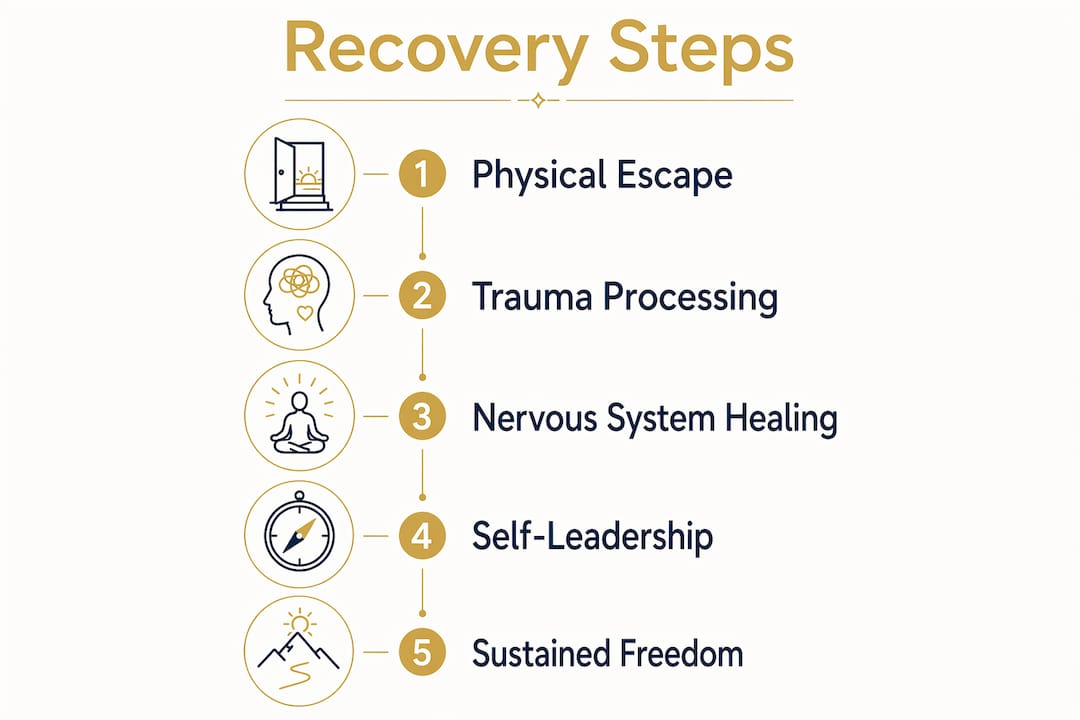
Her book, How to Heal After Narcissistic Abuse, provides structured exercises and the SELF Navigation Map, a practical tool for moving through post-traumatic stress toward growth. Her digital content has accumulated over 12 million YouTube views and millions of podcast downloads, which reflects how many women are actively seeking this kind of trauma-informed guidance. That reach matters because it signals a community, not just a course.
The table below compares the limitations of conventional approaches with what Caroline Strawson’s methodology offers:
| Approach | What it addresses | What it misses |
|---|---|---|
| Standard talk therapy | Cognitive patterns and narrative | Physiological trauma stored in the body |
| No-contact alone | Physical safety | Nervous system dysregulation and trauma bonds |
| Caroline Strawson’s method | Body, mind, identity, and growth | Requires ongoing commitment and practice |
| Positive psychology only | Resilience and mindset | Does not process stored somatic trauma |
Nervous system flexibility is the goal, not just symptom reduction. When your nervous system learns to feel safe again, you stop reacting from survival mode and start making choices from a grounded, self-directed place. That is what the carolinestrawson.com guidance is designed to build.
What are effective boundary setting and self-leadership strategies after escape?
Boundaries after narcissistic abuse are not preferences. They are protective structures that your recovery depends on. No-contact or strictly limited contact, including routing all communication through legal representatives when children or shared assets are involved, is often the most critical first boundary to establish. This removes the abuser’s primary tool: direct access to your emotional responses.

Dismantling trauma bonds requires more than willpower. These bonds are physiologically stored, meaning they activate the same neurological reward pathways as addiction. Recognizing this removes the shame from the process. You are not weak for feeling pulled back. You are healing a conditioned nervous system response.
Here is a practical sequence for building self-leadership after escape:
- Establish physical safety first. Secure your living situation, finances, and legal protections before focusing on emotional processing. Safety is the foundation everything else is built on.
- Set a communication protocol. If contact is unavoidable, use written channels only, keep exchanges factual, and never respond in real time. This prevents reactive engagement.
- Identify your trauma bond triggers. Work with a trauma-informed therapist or use somatic journaling to map which situations, words, or tones pull you back into old patterns.
- Practice somatic grounding daily. Techniques such as box breathing, cold water on the wrists, or slow bilateral tapping help regulate your nervous system in moments of activation.
- Shift the internal narrative. Move from “I need to fix this relationship” to “I am responsible for my own safety and growth.” This is the core mindset shift Caroline Strawson’s work reinforces.
Pro Tip: Women in high-control or religious environments often carry compounded guilt around boundary setting. Setting firm limits is not a moral failure. It is a spiritual and emotional act of self-respect.
You can also explore narcissist patterns to deepen your understanding of the behaviors you are protecting yourself from. Recognizing the pattern from the outside makes it far easier to hold your boundaries when the pull to engage feels overwhelming.
What resources support post-traumatic growth on the Caroline Strawson journey?
The caroline strawson journey does not end at escape. Post-traumatic growth is the process of building a life that is not just free from abuse, but actively expanded by the experience of surviving it. Caroline Strawson’s platforms offer multiple entry points for this ongoing work.
Key resources available through her ecosystem include:
- The How to Heal After Narcissistic Abuse book. Structured exercises and the SELF Navigation Map make this a practical workbook, not just a reading experience.
- Her podcast. With millions of downloads, it covers topics from trauma bonds to somatic healing and features expert guests across psychology and coaching.
- Free video series on YouTube. Over 12 million views reflect consistent, high-quality content on narcissistic abuse recovery.
- Somatic self-leadership practices. Grounding techniques, nervous system regulation exercises, and body-based awareness tools are woven throughout her content.
- Her Instagram community. With over 285,000 followers, her platform functions as a peer support space as well as an educational channel.
Positive psychology interventions, such as gratitude practices, strengths identification, and values clarification, are not fluffy additions to this work. They are evidence-based tools that build the neural pathways associated with hope and agency. When combined with somatic regulation, they accelerate the shift from survival to growth.
Healing is non-linear and requires body-based practices rather than cognitive approaches alone. Polyvagal theory, which explains how the nervous system moves between states of safety, threat, and shutdown, provides the scientific foundation for why somatic work is not optional in trauma recovery. It is the mechanism through which lasting freedom is built.
For additional reading that complements this work, Smartreadshub’s guide on emotional detachment offers practical steps for maintaining your emotional health while navigating the aftermath of a toxic relationship.
Key takeaways
True escape from narcissistic abuse requires nervous system regulation, somatic healing, and self-leadership, not just physical separation from the abuser.
| Point | Details |
|---|---|
| Recognize bodily signals | Anxiety, panic, and hypervigilance are reliable early warning signs, not overreactions. |
| Physical escape is the start | Trauma bonds persist after separation and require ongoing somatic and psychological work. |
| Use structured tools | Caroline Strawson’s SELF Navigation Map and book provide a practical framework for recovery. |
| Boundaries are non-negotiable | No-contact or legal-only communication channels protect your nervous system and recovery. |
| Growth is the destination | Post-traumatic growth, not just symptom relief, is the measurable goal of trauma-informed healing. |
Why escape is never just about leaving
I have spent years reading and writing about trauma recovery, and the single most damaging misconception I encounter is this: that escape means the hard part is over. It is not. For most women, the period immediately after leaving a narcissistic relationship is when the psychological weight becomes most visible. The hypervigilance does not switch off. The self-doubt does not disappear. The grief, yes, grief, for the relationship you thought you had, arrives in full force.
What Caroline Strawson’s work gets right, and what most mainstream advice misses, is that the body holds the score long after the mind has decided to move on. You can intellectually understand that you were manipulated and still feel physically compelled to reach out, apologize, or return. That is not weakness. That is an unregulated nervous system doing exactly what it was conditioned to do.
The Smartreadshub Caroline Strawson review goes deeper into how her methodology holds up under scrutiny, and I think it is worth reading if you are evaluating whether her approach fits your situation. What I will say here is that the integration of EMDR, IFS, and somatic work with positive psychology is not a marketing combination. It is a clinically grounded response to the fact that trauma lives in multiple layers simultaneously.
The women I see make the most durable recoveries are not the ones who left fastest. They are the ones who committed to understanding what happened in their bodies, not just their minds, and who found mentors and frameworks that honored that complexity. Caroline Strawson is one of the few voices in this space who consistently does both.
— Robert
Curated books and resources to support your healing
Healing from narcissistic abuse takes more than one resource, and Smartreadshub exists specifically to support women at every stage of that process. The site curates books and guides focused on gaslighting, emotional manipulation, trauma recovery, and boundary setting, all selected for their practical, evidence-informed approach. Whether you are still processing what happened or actively rebuilding your sense of self, the right book at the right moment can reframe everything.
Reading is not passive in this context. Research shows that books reduce emotional pain by offering both cognitive frameworks and emotional validation simultaneously. Explore the full collection of healing-focused books at Smartreadshub to find resources that meet you exactly where you are on your recovery path.
FAQ
What does “escape” mean in the context of narcissistic abuse recovery?
Escape from narcissistic abuse means both physical separation from the abuser and the ongoing process of nervous system regulation, boundary setting, and identity reclamation. Caroline Strawson defines it as a shift from post-traumatic stress toward post-traumatic growth using somatic and positive psychology tools.
How long does it take to heal from narcissistic abuse?
Healing is non-linear and varies by individual, but trauma bonds persist physiologically long after physical separation, meaning recovery typically requires sustained body-based work over months or years. Progress is measured by nervous system flexibility and self-leadership, not a fixed timeline.
Is no-contact always necessary after leaving a narcissistic relationship?
No-contact is the most protective boundary available, but when children or legal matters require ongoing communication, routing all contact through solicitors or written channels only is the recommended alternative. The goal is removing direct emotional access, not necessarily eliminating all communication.
What is the SELF Navigation Map?
The SELF Navigation Map is a structured framework developed by Caroline Strawson and featured in her book How to Heal After Narcissistic Abuse. It guides survivors through the stages of recognizing trauma, regulating the nervous system, and building toward embodied self-leadership and growth.
Can reading books actually help with trauma recovery?
Yes. Psychology books and trauma-informed guides provide both cognitive frameworks for understanding abuse patterns and emotional validation that reduces isolation. When combined with somatic practices, structured reading accelerates the shift from survival mode to post-traumatic growth.