

Relationship patterns are recurring emotional and behavioral cycles that replay across different partners, contexts, and years, often without the person caught inside them understanding why. Books that explain relationship patterns do this by applying structured psychological frameworks, including attachment theory, Jungian archetypes, and communication cycle models, to make the invisible visible. For anyone who has left a harmful relationship and found themselves asking “why does this keep happening to me,” literature built on these frameworks offers something therapy alone sometimes cannot: the ability to study your own patterns privately, at your own pace, with language that finally fits the experience.
How books explain relationship patterns through attachment theory
Attachment theory is the most widely used framework in relationship psychology books, and for good reason. It maps adult relational behavior directly onto early caregiving experiences, giving readers a concrete “why” behind patterns that previously felt random or shameful. Attachment-theory literature frames conflict not as a character flaw but as a predictable style, categorizing responses into four types: secure, anxious, avoidant, and disorganized. That reframe alone can be genuinely liberating for someone who has spent years believing they were simply “too much” or “not enough.”
The four attachment styles work as a map for identifying relationship patterns in yourself and your partners:
- Secure attachment produces consistent emotional availability and the ability to tolerate disagreement without catastrophizing.
- Anxious attachment drives hypervigilance to a partner’s moods, fear of abandonment, and a tendency to seek reassurance repeatedly.
- Avoidant attachment creates emotional distancing, discomfort with vulnerability, and a pull toward self-sufficiency even when connection is wanted.
- Disorganized attachment combines both anxious and avoidant responses, often linked to early experiences of fear within caregiving relationships.
Books like Attached by Amir Levine and Rachel Heller, and Hold Me Tight by Sue Johnson, translate these clinical categories into readable, relatable prose. They show how an anxious person paired with an avoidant partner creates a predictable cycle of pursuit and withdrawal that neither person consciously chooses. That recognition, seeing your own dynamic named and explained, is often the first moment a reader stops blaming themselves or their partner and starts analyzing patterns in relationships instead.
Pro Tip: When reading attachment-focused books, resist the urge to immediately label your partner. Start by identifying your own style first. Self-knowledge is the foundation; partner analysis comes second and is far less reliable without it.

The limitation worth noting is that attachment styles are tendencies, not sentences. Treating these labels as hypotheses rather than permanent verdicts protects against the trap of using psychological language to shame yourself or others. The best books in this space make that distinction explicit.
What Jungian psychology reveals about unconscious relationship cycles
Attachment theory explains the “what” of relationship patterns. Jungian and psychoanalytic frameworks go deeper and explain the “why beneath the why.” These books describe what psychologists call the relational unconscious: a layered set of internalized templates built from every significant relationship you have ever had, not just your parents. These templates operate below conscious awareness, shaping who you are drawn to, what you expect, and how you respond when those expectations are violated.
Jungian-inspired relationship books describe these templates as dynamic, blending archetypes and complexes that shape perceptions and emotional responses without your knowledge. The key concepts that appear across this literature include:
- Archetypes: Universal patterns of relating, such as the Caretaker, the Rescuer, or the Wounded Child, that organize how you unconsciously cast yourself and others in relational roles.
- Complexes: Emotionally charged clusters of memory and feeling, often formed around wounding experiences, that get activated by specific triggers in current relationships.
- Projection: The process of seeing your own unacknowledged traits, fears, or desires in a partner, which is a central mechanism in why certain people feel magnetically attractive or intensely threatening.
“We don’t fall in love with a person so much as with a story we are already telling ourselves.” This idea, central to Jungian relational theory, explains why the same dynamic can appear with entirely different people across a lifetime.
Psychotherapy that explores affective charged memories and relational images can reduce reactivity and support healthier connections. Books drawing on this tradition, such as Robert Johnson’s We: Understanding the Psychology of Romantic Love, help readers recognize when they are responding to the person in front of them versus the template they are projecting onto that person. That distinction is particularly powerful for survivors of narcissistic abuse or manipulation, where the gap between the real person and the projected ideal was weaponized. Smartreadshub covers this territory in depth for readers healing from narcissistic abuse.
George Saunders frames this beautifully: relationships are co-created intersubjective fields shaped by each partner’s patterns of love and loss. Moving beyond blame means studying the interaction itself, not just the individuals.
How communication cycles in books name and defuse conflict
One of the most practically useful things relationship literature does is name specific behavioral cycles that couples get locked into. The pursue-withdraw cycle is the most documented of these. One partner reaches for connection through talking, questioning, or emotional intensity. The other retreats for safety through silence, distance, or emotional shutdown. Each person’s response intensifies the other’s behavior, and the cycle feeds itself.
Imago Relationship Therapy, developed by Harville Hendrix and Helen LaKelly Hunt, gave this cycle a memorable label: the turtle and the octopus. Imago therapy terms “turtles” as those who withdraw for safety and “octopuses” as those who seek connection through reach and pursuit. The cycle is comforting in its familiarity but risks deepening disconnection without the right skills to interrupt it.
Books that explain this cycle typically offer a structured path for shifting it:
- Name the cycle, not the person. Saying “we are in the turtle-octopus pattern right now” externalizes the problem and reduces personal blame for both partners.
- Identify the underlying need. The octopus is not demanding; they are afraid of abandonment. The turtle is not cold; they are overwhelmed. Books help readers translate behavior into need.
- Use structured dialogue tools. Imago Dialogue, developed by Hendrix and Hunt, uses mirroring, validation, and empathy as a three-step conversation format that slows the cycle down deliberately.
- Schedule connection. Many books recommend designated conversation times to reduce the anxiety that drives pursuit in the first place.
Pro Tip: The pursue-withdraw cycle is often a manifestation of contrasting survival strategies, not incompatibility. Understanding this reframe is the first step toward transforming conflict into growth rather than evidence of a failing relationship.
Naming and externalizing relationship cycles helps reduce personalized blame and opens space for couples to practice healthier interaction. That shift from “you are the problem” to “this cycle is the problem” is one of the most therapeutic things a book can accomplish.
How relationship books support healing beyond pattern recognition
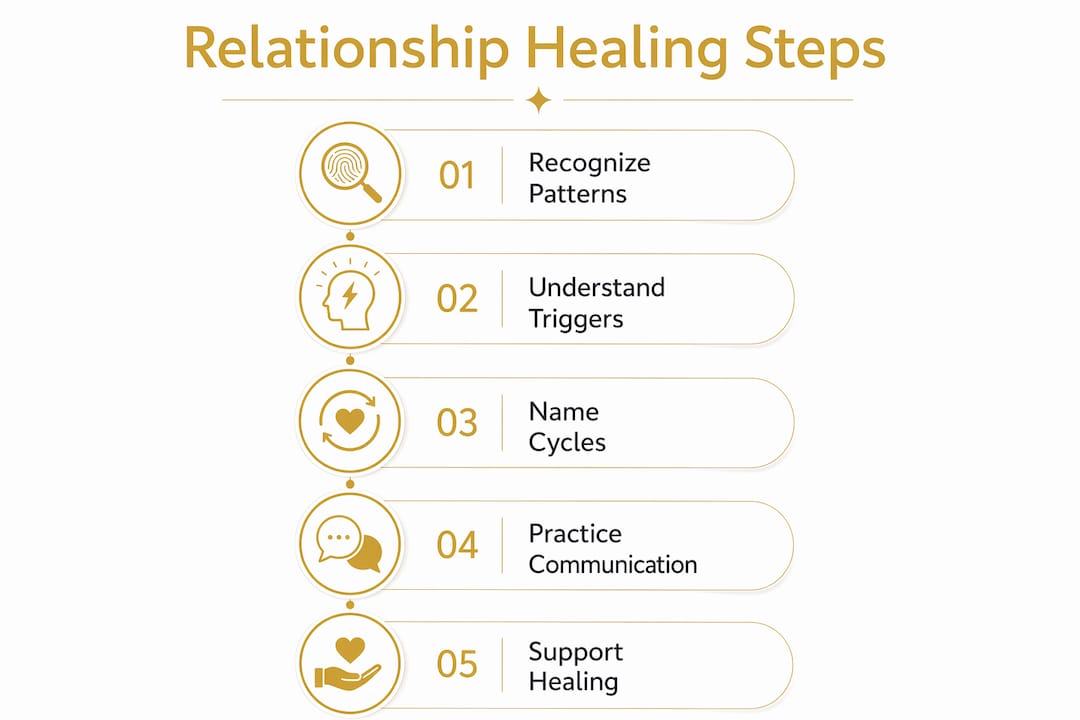
Recognizing a pattern is the beginning of change, not the change itself. Awareness alone is insufficient; deeper work in regulation and safer communication is necessary for true transformation. The best relationship books understand this and build in structured practice rather than stopping at conceptual explanation.
What effective healing-focused books provide:
- Exercises that connect triggers to core wounds. Rather than just explaining that anxious attachment causes hypervigilance, workbooks prompt readers to trace a specific recent trigger back to its earliest memory, making the pattern personal and concrete.
- Alternative response practice. Books with structured prompts serve as mechanisms for change rather than just conceptual understanding, giving readers scripts and scenarios to rehearse new behaviors.
- Somatic and regulation tools. Books combining cognitive understanding with body-based regulation skills lead to more durable change than insight alone, particularly for readers healing from relational trauma.
- Encouragement toward professional support. The strongest books in this space are honest that self-study has limits and actively point readers toward therapy, somatic work, or group support as complements to reading.
Shifting relationship patterns involves moving from feeling “loved” as a fixed state to engaging in moment-to-moment communication processes that allow practice and change. Books like How to Feel Loved propose conversational mindsets, including curiosity, open sharing, and emotional presence, as daily practices rather than one-time revelations. This is a critical distinction: healing is a process of repeated small choices, and the best books are designed to support that repetition. You can explore how self-discovery books support this kind of sustained growth in more depth.
Key takeaways
Books that explain relationship patterns work because they translate unconscious emotional cycles into named, learnable frameworks that readers can apply to their own lives.
| Point | Details |
|---|---|
| Attachment theory as a map | Books use secure, anxious, avoidant, and disorganized styles to reframe conflict as predictable patterns, not personal failures. |
| Jungian templates run deep | Archetypes and complexes shape who you are drawn to and why the same dynamic repeats across different partners. |
| Naming cycles reduces blame | Labels like “turtle and octopus” externalize the problem, shifting focus from fault to the interaction pattern itself. |
| Awareness requires practice | Recognition is a starting point; workbooks, exercises, and regulation tools are what produce lasting behavioral change. |
| Labels are hypotheses | Treating pattern labels as working theories rather than fixed verdicts protects self-compassion and supports healing progress. |
What I’ve learned about using relationship books as healing tools
I have read hundreds of relationship psychology books over the years, and the most important thing I can tell you is this: the books that changed readers’ lives were not the ones with the most sophisticated theory. They were the ones that made a person feel seen before they felt analyzed.
The risk with psychological frameworks is that they can become another form of self-criticism. I have watched readers use attachment theory to build a case against themselves, cataloging every anxious behavior as evidence of being broken. That is the opposite of what these books intend. The frameworks exist to create distance between you and the pattern, not to fuse you more tightly to a label.
What I find genuinely useful is treating every model, whether attachment theory, Jungian archetypes, or the turtle-octopus cycle, as a lens rather than a verdict. You pick it up, look through it, see what it illuminates, and then put it down. No single framework captures the full complexity of a human relationship. The readers who heal most effectively are the ones who use books as a starting point for curiosity, not a finishing point for judgment.
The other thing I want to say directly: if you are recovering from a psychologically harmful relationship, books are a legitimate and powerful resource. They give you language when you have none, company when you feel alone, and structure when everything feels chaotic. But they work best alongside real relational safety, whether that is a good therapist, a trusted friend, or a community of people who understand what you have been through. Reading about toxic relationship patterns is not the same as healing from them. It is, however, an excellent place to begin.
— Robert
Deepen your healing with curated book recommendations
Smartreadshub curates book recommendations specifically for readers navigating the aftermath of psychologically harmful relationships. Whether you are working through attachment wounds, trying to understand manipulation tactics, or simply looking for the next right book to read, the selections here are chosen with your experience in mind. Browse the self-discovery books collection for titles that pair psychological insight with practical healing frameworks. For readers focused on emotional release and moving forward, the emotional healing picks offer a curated path through grief, recovery, and renewal. Every recommendation on Smartreadshub is chosen to complement, not replace, the professional support you deserve.
FAQ
What psychological frameworks do relationship books use most?
Attachment theory, Jungian archetypes, and communication cycle models like the pursue-withdraw pattern are the three most common frameworks. Each explains a different layer of how recurring relationship dynamics form and persist.
Can reading about relationship patterns actually change behavior?
Recognition alone rarely produces lasting change. Effective books combine conceptual frameworks with structured exercises, prompts, and regulation tools that build new responses through repeated practice rather than insight alone.
What is the turtle-octopus pattern in relationship books?
The turtle-octopus pattern, developed within Imago Relationship Therapy by Harville Hendrix and Helen LaKelly Hunt, describes a pursue-withdraw cycle where one partner seeks connection through emotional reach and the other retreats for safety. Naming the cycle reduces personal blame and opens space for healthier communication.
How do I avoid using attachment labels as self-criticism?
Treat attachment style labels as hypotheses rather than fixed identities. Pattern labels are tools for exploration and self-compassion, not verdicts. Revisiting them as your understanding grows is part of the healing process.
Should relationship books replace therapy?
Relationship books are a powerful complement to therapy, not a substitute. They provide language, frameworks, and private reflection space, but books combining insight with somatic work and professional support produce more durable healing than reading alone.