

Breakup books are defined as a category of bibliotherapy that uses structured narrative and emotional guidance to help readers process grief, reduce uncertainty, and rebuild identity after a relationship ends. The psychological term for this practice is bibliotherapy, and understanding why breakup books work requires looking at what happens inside the brain when you read a story that mirrors your own pain. Research from Frontiers in Psychiatry, a 2026 Nature study on expressive writing, and reporting from the New York Times all confirm that reading the right book at the right time is not passive comfort. It is an active form of emotional processing that produces measurable psychological change.
Why breakup books work: the science behind the healing
Bibliotherapy is the clinical term for using reading as a therapeutic tool, and the evidence for its effectiveness is stronger than most people realize. A 2025 Frontiers meta-analysis found that reading-based interventions produced a standardized mean difference of −0.52 for depressive symptom relief. That number means bibliotherapy participants experienced roughly half a standard deviation less depression than those who received no intervention. Over two years, only 3% of the bibliotherapy group developed new depression, compared to 23% in the control group. That gap is not trivial. It represents a real, sustained shift in mental health outcomes driven by reading.
The mechanisms behind these results fall into three categories. First, emotional resonance: when a book describes exactly how you feel, your nervous system registers recognition rather than isolation. Second, cognitive restructuring: a well-written breakup book reframes the experience from personal failure to a human process with identifiable patterns. Third, social connectedness: reading about characters or real people who survived what you are going through activates the same neural pathways as receiving social support. The Frontiers article outlines how narrative engagement and character similarity enhance psychological recovery through all three channels simultaneously.

Fiction reading adds another layer. A 2025 Springer study found that literary fiction uniquely sharpens emotion recognition by requiring readers to infer implied emotions rather than having them stated outright. This trains what psychologists call mentalizing, the ability to understand your own and others’ emotional states. For someone in the fog of a breakup, that skill is exactly what has gone offline. Reading fiction that shows rather than tells emotion rebuilds it.
Expressive writing research adds further support. A 2026 Nature study tracking structured expressive writing over six months found a gradual increase in positive emotions alongside regulated negative emotions. The key word is regulated. The benefit came not from venting raw emotion but from combining emotional engagement with reflection. Breakup books that include journaling prompts, reflection pauses, or structured exercises mirror this exact process.
- Emotional resonance normalizes grief and reduces the shame that often accompanies a breakup
- Cognitive restructuring replaces chaotic “why did this happen” loops with understandable explanatory models
- Social connectedness through character identification reduces the isolation that intensifies post-breakup pain
- Mentalizing training via literary fiction rebuilds emotional intelligence that grief temporarily disrupts
How breakup books create clarity from emotional chaos
One of the most disorienting parts of a breakup is the loss of narrative. You had a story about your relationship and your future, and that story has been abruptly deleted. Breakup books work in part because they supply a replacement framework, a way to organize what happened into something that makes sense.
The New York Times framed this precisely in its 2025 reporting on breakup books, describing them as tools that “remove the mystery” around why breakups happen. That phrase captures something clinically real. Uncertainty is one of the primary drivers of rumination. When you do not understand why something happened, your brain keeps returning to the question in an attempt to resolve it. A book that provides an explanatory model, whether psychological, attachment-based, or narrative, gives the brain something to work with. The mental rehearsal loop quiets because the question has been partially answered.
Structured narratives also transform ruminative questioning into mental models that ease emotional burden. The “why” and “what if” questions that cycle at 2 a.m. are not random. They are your mind trying to build a coherent story. A breakup book accelerates that process by providing vocabulary, frameworks, and arcs that your own mind is struggling to generate while under emotional stress.
Pro Tip: Read in short, focused sessions of 20 to 30 minutes rather than long marathon reads. Pausing to write two or three sentences about what resonated gives your brain time to integrate the material rather than just absorb it.
Pacing matters here. Reading too much too fast can flood you with emotion before you have the cognitive bandwidth to process it. Guided bibliotherapy programs typically structure reading in doses, and independent readers benefit from applying the same discipline. The goal is reflection, not speed.
What types of breakup books exist and how do they differ
Not all breakup books operate the same way, and choosing the wrong type for your current emotional state can slow rather than support recovery. The three main categories are emotional catharsis books, cognitive restructuring guides, and literary fiction with implicit emotional learning.
| Type | Primary mechanism | Best for | Potential limitation |
|---|---|---|---|
| Emotional catharsis books | Validation and grief normalization | Early stages of grief when you need to feel seen | May reinforce rumination without resolution |
| Cognitive restructuring guides | Reframing and behavioral steps | When you are ready to understand patterns and move forward | Can feel clinical if grief is still raw |
| Literary fiction | Implicit emotion training and mentalizing | Rebuilding emotional intelligence and empathy | Benefits are slower and less direct |
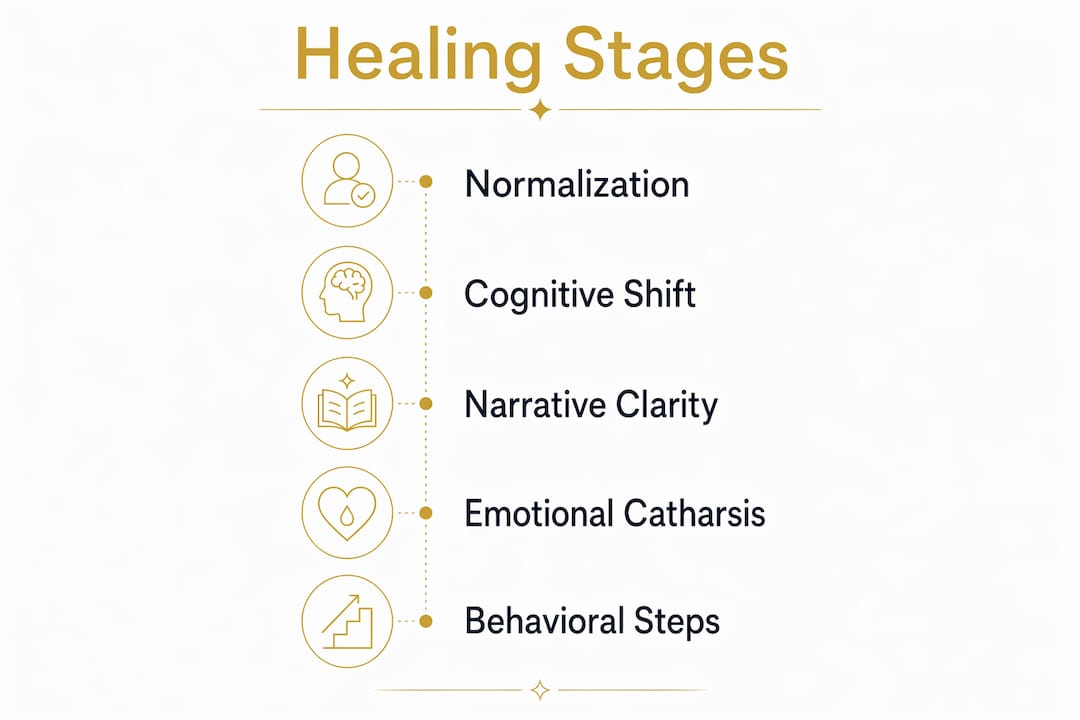
The most effective breakup books combine all three elements: they normalize grief, provide explanatory models, and include practical behavioral steps. Books that rely only on catharsis, the “cry it out” approach, may feel satisfying in the moment but do not produce the cognitive restructuring that leads to lasting recovery.
Literary fiction deserves special mention. A novel like Normal People by Sally Rooney or Conversations with Friends does not tell you how to heal. It shows you emotional complexity in action, and your brain does the therapeutic work of inference. The Springer 2025 research confirms that implied emotion in literary fiction produces stronger mentalizing development than explicitly stated emotion in popular fiction. This is why reading a novel can sometimes feel more healing than reading a self-help guide, even though the novel never mentions attachment theory.
Books that include no-contact guidelines, journaling prompts, or step-by-step behavioral exercises add a practical dimension that pure narrative cannot. For readers who want both emotional resonance and concrete tools, titles that blend memoir with structured exercises tend to deliver the most complete healing experience. Smartreadshub curates books on emotional detachment that cover exactly this combination.
Who benefits most from breakup books and when to be cautious
The benefits of breakup books are real, but they are not universal. Individual differences in trauma history, attachment style, and current emotional regulation capacity all affect how a person responds to reading-based healing.
For most people going through a standard, painful breakup, bibliotherapy is safe and beneficial. The research supports it across a wide range of emotional states. The caution applies specifically to people with significant trauma histories or deep attachment injuries. The 2026 Nature study found that some trauma-affected participants were overwhelmed by unstructured emotional expression, experiencing symptom escalation rather than relief. Catharsis without regulation is the risk factor. A book that opens emotional wounds without providing tools to close them can leave a trauma-sensitive reader worse off than before.
This does not mean people with trauma histories should avoid breakup books. It means they should prioritize books that include regulation techniques alongside emotional content. Books that teach grounding exercises, breathing practices, or cognitive reframing alongside grief processing are safer for this population. Pairing reading with professional support, whether a therapist, a counselor, or a structured support group, provides the scaffolding that makes the reading productive rather than destabilizing.
Pro Tip: If you notice that reading a particular book consistently leaves you feeling worse rather than processing, that is useful information. Set it aside and try a more regulation-focused title, or bring what you are reading into a therapy session to work through it with support.
Reading engagement quality also matters more than quantity. Distracted or fragmented reading reduces the emotion-processing benefits significantly. Thirty focused minutes with a breakup book outperforms two hours of reading while scrolling your phone between chapters. The therapeutic effect requires genuine mental presence.
How to choose and use breakup books effectively
Selecting the right breakup book starts with an honest assessment of where you are emotionally. Are you in the acute grief phase, where validation and normalization are the priority? Or are you past the initial shock and ready to understand patterns and rebuild? The answer determines which type of book will serve you best.
- Assess your emotional readiness. If you are still in the “I cannot believe this happened” phase, start with a book that validates grief rather than one that immediately pushes toward growth. Premature positivity can feel dismissive of real pain.
- Read slowly and reflectively. Treat each chapter as a conversation rather than content to consume. Pause when something resonates and write a sentence or two about why.
- Keep a reading journal. Combining reading with journaling mirrors the structured expressive writing approach that the 2026 Nature research found most effective for emotional transformation.
- Use breakup books as one part of a larger toolkit. Reading works best alongside other supports: therapy, trusted friendships, physical movement, and time. No single book replaces a full healing ecosystem.
- Revisit books at different stages. A book that felt too prescriptive in week two of a breakup may feel exactly right at month three. Your emotional readiness changes, and so does what you need from a text.
For curated recommendations organized by healing stage, Smartreadshub’s guide to self-help books after divorce applies equally well to non-marital breakups and offers a structured starting point.
Key takeaways
Breakup books work because they apply bibliotherapy’s three core mechanisms, emotional resonance, cognitive restructuring, and social connectedness, to the specific psychological disruption caused by relationship loss.
| Point | Details |
|---|---|
| Bibliotherapy reduces depression | A 2025 Frontiers meta-analysis found only 3% new depression onset in bibliotherapy groups versus 23% in controls. |
| Narrative clarity reduces rumination | Breakup books supply explanatory frameworks that quiet the “why” loops driving post-breakup anxiety. |
| Literary fiction trains emotion skills | Implied emotion in literary fiction builds mentalizing ability, which grief temporarily disrupts. |
| Pacing and reflection maximize benefit | Short, focused reading sessions paired with journaling produce stronger emotional processing than passive reading. |
| Trauma-sensitive readers need regulation | Books combining emotional content with regulation tools are safer and more effective for those with attachment injuries. |
What I have learned from years of watching readers heal through books
The most common mistake I see readers make with breakup books is treating them like medicine to be taken in large doses as fast as possible. They buy three titles, read all of them in two weeks, and then wonder why they still feel terrible. Reading speed is not healing speed.
What actually works, based on everything the research shows and everything I have observed through Smartreadshub’s reader community, is slow, intentional engagement with one book at a time. The readers who report the most meaningful shifts are the ones who underline sentences, write in margins, and stop mid-chapter to sit with what they just read. They are not consuming the book. They are having a conversation with it.
The other thing I want to say plainly: breakup books are powerful companions, but they are not substitutes for professional help when the pain runs deep. If you are dealing with a relationship that involved abuse, significant trauma, or a loss that has triggered a mental health crisis, a book is a supplement, not a solution. The survivors guide from Rachel M. Harrison is one resource I point readers toward when the healing needed goes beyond what reading alone can provide.
What I find genuinely moving about breakup literature is that it works precisely because it is human. A well-written breakup book reminds you that your specific, private, devastating experience is also universal. That recognition, that you are not uniquely broken, is sometimes the most therapeutic sentence on the page.
— Robert
Find your next healing read at Smartreadshub
Smartreadshub curates breakup and emotional recovery books selected for their alignment with evidence-based healing principles, not just their popularity. Whether you are in the raw early stages of grief or ready to rebuild your sense of self, the right book exists for where you are right now.

Browse the top picks for emotional healing to find titles organized by healing stage, from grief normalization through cognitive restructuring and identity rebuilding. If you want to go deeper into how reading supports personal growth beyond the breakup itself, the self-discovery books guide at Smartreadshub offers a research-informed path forward.
FAQ
Why do breakup books help with emotional recovery?
Breakup books apply bibliotherapy principles, including emotional resonance, cognitive restructuring, and narrative clarity, to help readers process grief and reduce the uncertainty that drives post-breakup rumination. A 2025 Frontiers review confirms reading-based interventions significantly reduce depressive symptoms compared to no intervention.
Are breakup books as effective as therapy?
Breakup books are effective for most people experiencing typical relationship grief, but they are not a replacement for therapy when trauma, abuse, or clinical depression is involved. They work best as part of a broader healing toolkit that may include professional support.
What type of breakup book works best?
Books that combine grief normalization, explanatory models, and practical behavioral steps produce the strongest outcomes. Pure catharsis books without regulation tools can reinforce rumination rather than resolve it, particularly for readers with trauma histories.
How should I read a breakup book for maximum benefit?
Read in focused 20 to 30 minute sessions and pause to journal after sections that resonate. The Springer 2025 research confirms that slow, reflective reading paired with writing produces significantly stronger emotional processing than passive or distracted reading.
Can breakup books make things worse?
For most readers, no. For individuals with significant trauma or attachment injuries, books focused only on emotional catharsis without regulation tools can temporarily intensify symptoms. Choosing regulation-focused titles and pairing reading with professional support reduces this risk substantially.