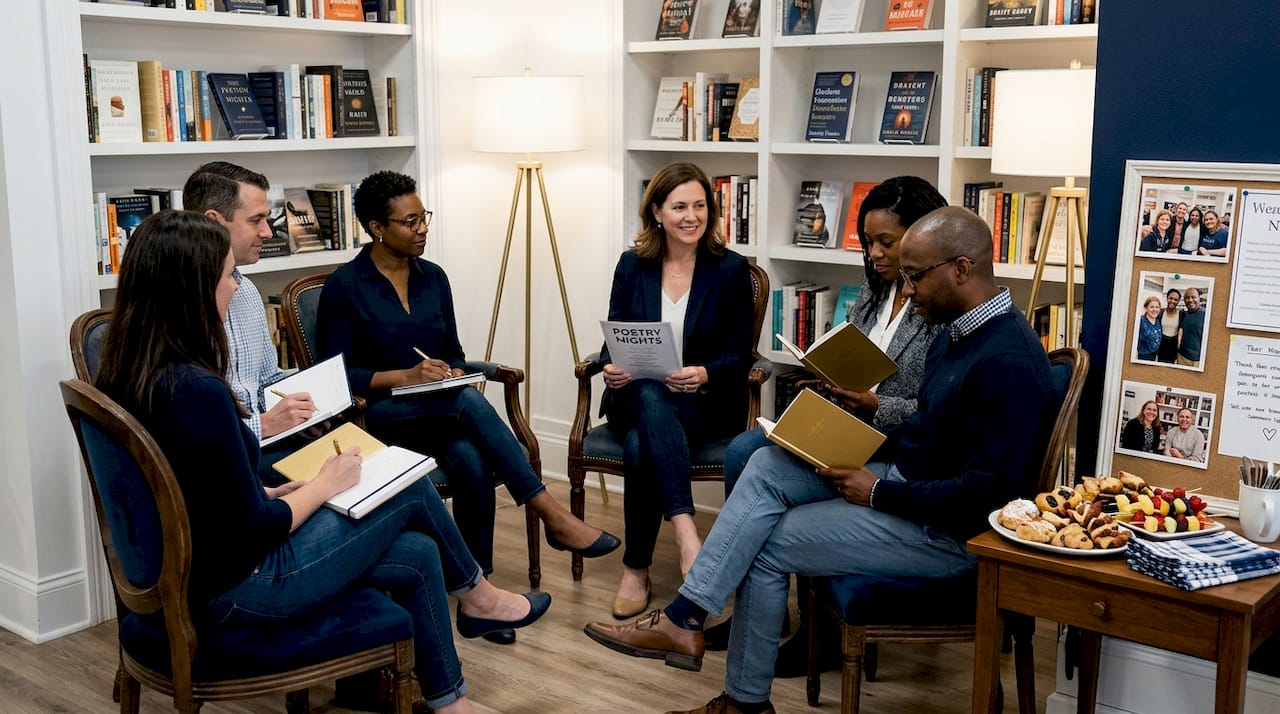
You already know a bookstore sells books. What you might not realize is that the role of independent bookstores in healing runs far deeper than any shelf or price tag. These spaces have quietly become some of the most powerful community resources in American life, operating less like retail outlets and more like informal sanctuaries where grief gets spoken aloud, strangers become friends, and people leave feeling less alone. This article unpacks why that transformation happened, what it means for your own wellbeing, and how you can tap into it intentionally.
| Point | Details |
|---|---|
| Bookstores as third spaces | Indie bookstores serve as neutral gathering grounds beyond home and work, creating conditions for organic emotional support. |
| Healing through human connection | In-person conversations at bookstores fulfill emotional needs that virtual interactions and algorithms simply cannot replicate. |
| Programming expands impact | Events like reading groups, workshops, and game nights extend healing well beyond the act of reading itself. |
| Physical atmosphere matters | Slow-paced, welcoming design creates psychological safety that encourages honest conversation and emotional openness. |
| Anyone can participate | You do not need to buy a book to benefit. Showing up, joining a group, or attending an event is enough to begin. |
Sociologists use the term “third space” to describe gathering places that are neither home nor workplace. Think barbershops, diners, community gardens. They are places where social hierarchies soften and conversation flows without agenda. Independent bookstores have become the defining third space of this decade, and the timing is not accidental.
ABA membership has grown by over 500 members in a single year, reaching 3,417 members across 3,783 locations. ABA CEO Allison Hill put it plainly: “People are craving connection, especially in-person connection. It feels really healing.” That quote from a trade association CEO is striking precisely because it has nothing to do with inventory or profit margins.
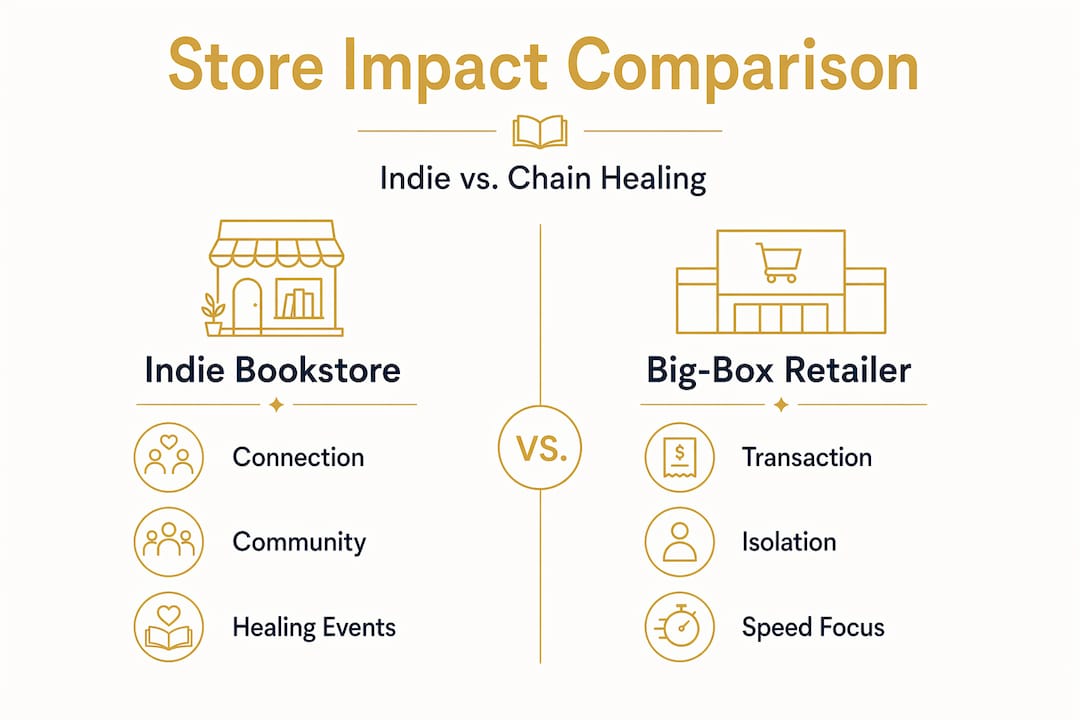
Compare this to big-box bookstore chains and online retailers. Both are optimized for transaction speed. You search, you click, you leave. The independent bookshop does the opposite. It invites you to slow down, wander, and linger without pressure to buy. That design difference is not accidental either. It is the foundation of everything that makes these spaces therapeutically useful.
Pro Tip: If you have been dismissing your local indie bookshop as just another store, walk in without a specific title in mind. Give yourself 30 minutes to browse. Notice what happens to your breathing and your sense of time.
| Feature | Independent bookstores | Big-box / online retailers |
|---|---|---|
| Pace of interaction | Slow, unhurried | Fast, transaction-focused |
| Staff relationship | Personal, ongoing | Minimal or algorithmic |
| Community programming | Regular events, groups | Rare or absent |
| Space for conversation | Encouraged | Not prioritized |
ABA CEO Hill framed this directly: indie bookstores are “maybe 50% books and 50% community,” and the healing comes from the gathering function, not the inventory. That framing reorients everything. The books are a reason to show up. The people are why you keep coming back.
Reading groups at independent bookstores function as what researchers and practitioners sometimes call bibliotherapy, a practice that uses literature to support emotional processing. But in a bookstore setting, the formal label disappears. Nobody signs a consent form. People just sit together and talk about a book, and somewhere in that conversation someone mentions their own grief, their own fear, or their own version of what the character went through.
Reading circles have been described as “a centre for therapy,” where dependable social ties emerge and conversations about taboo topics like postpartum struggles and grief become possible precisely because the setting feels low-stakes. Nobody is in a therapist’s chair. Everyone is just talking about a book.
Here is what makes this dynamic so specific to indie bookstores:
“The space allows people to have conversations they can’t have anywhere else, about things they’re not ready to label yet.”
Pro Tip: If you are going through a difficult season personally, look for a bookstore-hosted reading group focused on a genre you love. The shared interest gives you something to talk about immediately, which takes the pressure off the deeper conversation that often follows naturally.
Understanding why emotionally intense literature works in these settings is worth exploring further. Smartreadshub’s piece on why sad books feel comforting unpacks the science behind that effect in detail.
The healing impact of indie bookstores multiplies when the programming expands beyond reading. Bookstores host events like monthly pie and board game nights, printmaking classes, and community-specific clubs. These are not marketing gimmicks. They are deliberate efforts to create multiple entry points for people who might not identify as “readers” but still need a place to belong.
This matters because healing is not a single-track experience. For someone processing anxiety, a printmaking class at a bookstore might reach them more effectively than a novel. For someone newly divorced, a game night with familiar faces might be the first evening they have laughed in months.
Consider what a well-run indie bookstore programming calendar actually delivers:
| Type of programming | Primary healing function | Who benefits most |
|---|---|---|
| Reading groups | Emotional processing, empathy building | People dealing with grief, isolation, or identity questions |
| Creative workshops | Stress relief, self-expression | Those who process through making rather than talking |
| Affinity clubs | Belonging, identity affirmation | Marginalized or underrepresented communities |
| Social events | Connection, laughter, ease | Anyone dealing with loneliness or social anxiety |
Programming-centered healing has made small-town bookstores into multi-use community hubs that support emotional regulation in ways the town library or coffee shop simply do not replicate.
The atmosphere of an independent bookshop is not decoration. It is function. The physical environment, including inviting layout, ambient lighting, and space designed for lingering, creates the psychological safety that makes healing conversations possible. You cannot rush what you experience in a good bookstore. That is by design.
Think about what the physical setup actually signals to your nervous system:
The contrast with high-turnover retail is stark. A chain store optimizes every square foot for conversion. An indie bookshop optimizes for experience. That difference changes what is emotionally possible when you walk through the door.
The most important thing to understand about healing through local bookstores is that participation is the mechanism. Browsing alone has value, but the deeper benefits come from showing up repeatedly and engaging with the community around you.
Here is how to start, regardless of where you are in your healing journey:
Bookshop.org has channeled over $46 million back to local bookshops, proving that supporting these stores financially, even through online purchases, keeps the physical community spaces alive. When you buy through platforms that route revenue to indie shops, you are investing in the healing infrastructure of your own community.
Pro Tip: If social anxiety makes in-person events feel like too much at first, follow your local bookstore on social media and engage with their posts. That low-stakes digital familiarity often makes walking through the door the second time feel surprisingly easy.
For a deeper look at how books themselves support healing journeys, psychology books that aid healing is a well-researched starting point.
I have spent years watching how people interact with books and with each other in bookstore settings, and I want to be honest about something that most coverage of this topic skips past. The healing does not come from the books. Not primarily.
Books are the excuse. They give people a reason to show up, a shared object to point at, and a safe way to introduce emotional topics without saying “I am struggling and I need people.” That indirection is not weakness. It is wisdom. The bookshop provides cover that allows real vulnerability to emerge on its own schedule.
What I have also observed is that indie bookstore communities tend to be unusually tolerant of people who show up and say very little. You can attend a reading group for three months, listen more than you speak, and still be genuinely welcomed. That tolerance is rare in most social settings, and it is precisely what makes these spaces accessible to people who are in the deepest phases of grief or anxiety.
The thing that consistently surprises me is how durable these connections become. Someone who joined a reading group during a divorce or a health crisis will often still be attending years later, long after the crisis has passed. They stay because the space gave them something they did not know they needed, and they are not willing to give it back.
My honest advice: stop waiting until you feel ready to engage with your community. The bookstore will meet you where you are.
— Robert
If reading this has made you think about your own healing path, the next step is finding the books that speak directly to where you are right now.
Smartreadshub curates reading lists specifically for people working through grief, identity questions, personal growth, and emotional recovery. Whether you are looking for books on letting go after a major life change, or you want to understand yourself better through self-discovery reading, the recommendations are chosen with your emotional experience in mind, not just bestseller rankings. Pair those titles with your local indie bookshop community, and you have something genuinely powerful. Browse the full healing books collection at Smartreadshub to find your next read.
Independent bookstores function as third spaces, neutral ground outside home and work, where people gather for reading groups, events, and unplanned conversations. The healing derives primarily from human-to-human connection rather than the books themselves.
No. Attending events, joining reading groups, or simply spending time in the space contributes to your wellbeing and to the community without requiring a purchase. Your presence itself has value.
Reading groups at indie bookstores create informal settings where taboo topics like grief and personal struggles become easier to discuss because the shared book provides a low-pressure starting point for conversation.
They are genuinely growing. ABA membership reached 3,417 members at 3,783 locations after adding over 500 new members in a single year, reflecting real demand for the community and healing functions these spaces provide.
Programming typically includes reading groups, author talks, creative workshops like printmaking or journaling, affinity-based clubs for specific communities, and social events like game nights. Each format serves a different emotional need and welcomes people at different points in their healing journey.