

There’s a simple story about why women read more books than men, and it usually goes something like this: women just like reading more. End of story. But that explanation flattens something genuinely fascinating. The gender gap in reading habits is real and measurable, and researchers who study it have found that psychology, social behavior, and habit formation all play a role. Understanding those factors doesn’t just satisfy curiosity. It offers women who love reading a richer way to think about why books matter so much to them.
Table of Contents
- Key takeaways
- Why women read more books: what the data actually shows
- The emotional psychology of why women love to read
- Social reading and community as habit reinforcers
- Habit formation and practical reading behaviors
- Debunking the stereotypes about gender and reading
- My take on the reading gender gap
- Find your next great read at Smartreadshub
- FAQ
Key takeaways
| Point | Details |
|---|---|
| Women read more across formats | 78% of women read at least one book in the past year versus 71% of men, spanning print, e-books, and audiobooks. |
| Empathy drives fiction preference | Higher trait empathy links to stronger engagement with fiction, which research ties to improved emotion recognition. |
| Social reading reinforces habits | Book clubs, which women join at twice the rate of men, turn reading into identity and community. |
| Habit cues sustain frequency | Pairing reading with daily routines like morning coffee or post-dinner wind-down builds lasting reading behavior. |
| Stereotypes miss the real cause | Men’s lower reading frequency is shaped more by social and structural factors than by disinterest in certain books. |
Why women read more books: what the data actually shows
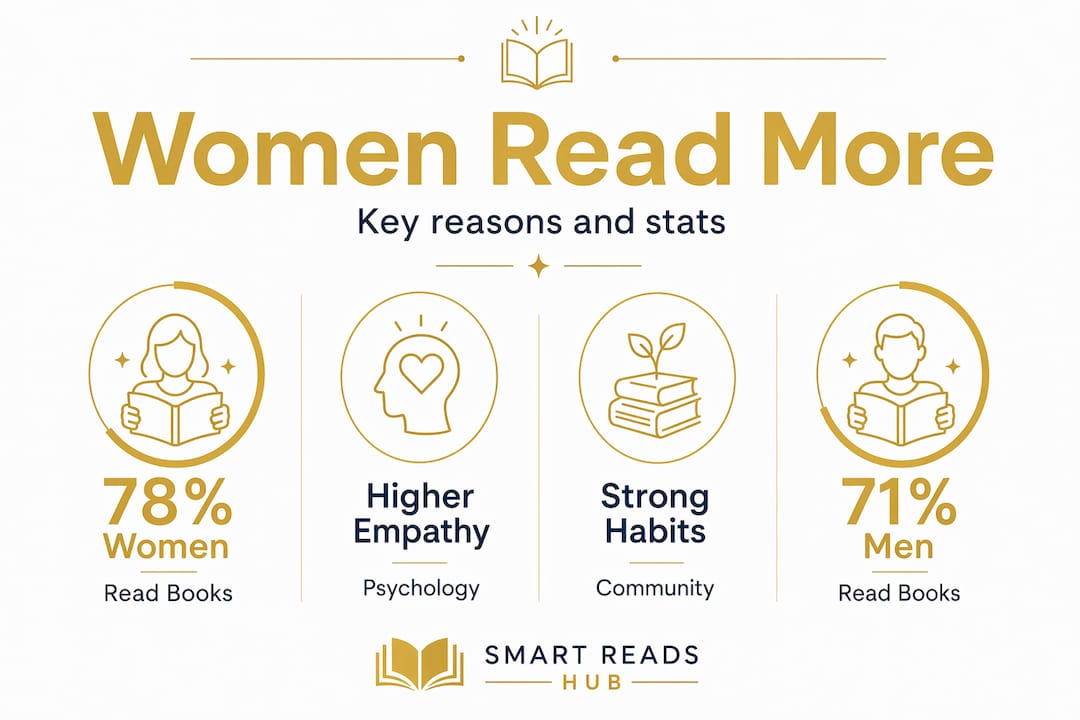
Before getting to the psychology, it helps to get the numbers straight. According to Pew Research Center, 78% of women read at least one book in any format over the past 12 months, compared to 71% of men. That gap holds across every format researchers tracked.
| Format | Women | Men |
|---|---|---|
| Any book (all formats) | 78% | 71% |
| Print books | 68% | 60% |
| E-books | 33% | 28% |
| Audiobooks | 27% | 24% |
| Book club participation | 10% | 5% |
What stands out here is the consistency. This isn’t a story about women preferring one format while men prefer another. Across print, e-book, and audiobook formats, women participate at higher rates. That points to a structural difference in reading behavior, not just a content preference. Researchers sometimes call this a “habit ecology” difference, meaning the entire ecosystem surrounding reading, which includes access, routine, and community, favors women in ways that show up across all formats.
The emotional psychology of why women love to read
This is where the research gets genuinely interesting. One of the strongest explanations for women’s higher fiction engagement connects to empathy. People with higher trait empathy tend to find fiction more rewarding because stories offer a safe space to experience and process other people’s inner lives. While empathy varies significantly among individuals and doesn’t divide neatly along gender lines, research consistently finds that fiction readers who engage deeply with characters show stronger emotion recognition skills over time.
A 2025 study found that readers assigned to literary fiction scored higher on emotion recognition than those reading popular fiction. Literary fiction tends to leave more emotional ambiguity for the reader to interpret, which exercises the mental muscles involved in understanding others. This creates a reinforcing loop. Reading fiction sharpens emotional perception, which makes fiction more engaging, which drives more reading.
Researchers studying fiction engagement have developed a framework called the RAISE model to explain this. RAISE stands for Reflection, Acquisition, Immersion, Socialization, and Expression. A recent study found significant links between RAISE mechanisms and psychological well-being, suggesting that fiction reading isn’t just entertainment. It actively supports flourishing. Each element of the model captures a different reason people find fiction compelling.
- Reflection: Fiction gives readers a structured way to examine their own experiences and feelings through a character’s journey.
- Acquisition: Readers gain vocabulary, cultural knowledge, and new perspectives they wouldn’t encounter in daily life.
- Immersion: The experience of being fully absorbed in a story provides restorative mental rest, similar to mindfulness.
- Socialization: Stories create shared references and emotional common ground with other readers.
- Expression: Engaging with fiction supports self-expression and identity formation, particularly during major life transitions.
Understanding why sad books feel comforting connects directly to this model. The emotional processing fiction offers isn’t an accident. It’s one of reading’s most reliable psychological rewards.
Pro Tip: If you want to deepen your emotional engagement with books, choose literary fiction that leaves character motivations slightly ambiguous. Your brain works harder to fill the gaps, which builds the same empathy skills researchers found in high-frequency readers.
Social reading and community as habit reinforcers
Reading might look like a solo activity, but for many women it functions as a social one. Pew’s data shows that book club participation is twice as high among women compared to men, with 10% of women versus 5% of men participating. That gap matters more than it might seem.
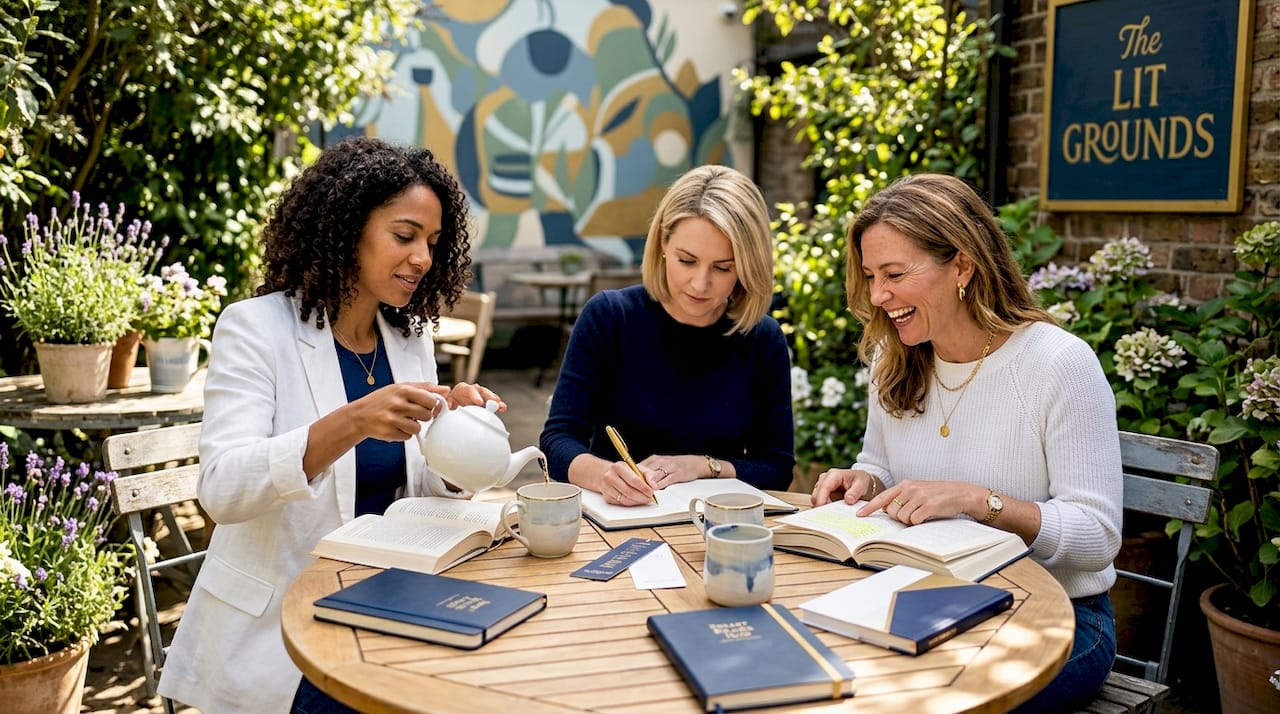
Book clubs don’t just give readers something to talk about. They create accountability, social identity, and a built-in reason to finish books on a schedule. When reading becomes part of how you connect with people you care about, it stops being optional. It becomes woven into the social fabric of your week. Researchers studying reading communities found that they help reduce loneliness and increase belonging, particularly among adults who feel isolated.
The generational trend here is worth noting. According to recent data, 21% of Gen Z and 29% of millennials belong to book clubs, with younger women driving much of that growth. Online communities have expanded what a book club can look like, moving it from a living room to a Discord server or an Instagram comment section. The underlying mechanism is the same though. Social reading reinforces reading habits in ways that solo reading simply cannot.
Here’s what strong social reading habits tend to share:
- A consistent meeting rhythm that creates predictable accountability
- Diverse book selections that expose readers to genres they wouldn’t choose alone
- Discussion formats that reward careful reading, not just finishing
- A culture that celebrates rather than judges reading pace or taste
Pro Tip: You don’t need a formal book club to get the social benefits of shared reading. A two-person text thread where you swap highlights and reactions from the same book creates enough accountability to meaningfully increase how often you read.
Habit formation and practical reading behaviors
Reading frequency comes down to habit more than motivation. Motivation is unreliable. Habits run on autopilot. Research on rebuilding reading habits emphasizes one core principle: pair your reading with an existing daily routine so that the routine becomes a cue.
The reason this matters for understanding female reading habits is practical. Women who read a lot rarely describe sitting down and deciding to read. They describe reading as something that happens at a particular time, in a particular place, attached to a particular activity. That’s habit architecture at work.
Here’s a practical sequence for building a reading habit that actually sticks:
- Identify your existing cue. Pick a daily activity you already do without thinking. Morning coffee, a lunch break, the train ride home, or the 20 minutes before sleep all work.
- Attach a small reading goal to that cue. Not a page count. A time block. Even 10 minutes counts.
- Choose the right format for that moment. Audiobooks work brilliantly during commutes or while cooking. Print works better at night when screen fatigue sets in.
- Remove the friction. Keep a book on your kitchen table, have your audiobook app already loaded, and make starting as easy as possible.
- Track completion, not speed. The goal is frequency, not racing through books. Finishing three books slowly beats abandoning six books quickly.
Format choice deserves particular attention. The reading ecosystem difference Pew’s data shows across print, e-books, and audiobooks suggests that women are more likely to match format to context. A woman who reads print at home, listens to audiobooks while commuting, and uses an e-reader while traveling is effectively reading in three different modes. That flexibility multiplies reading time without requiring more effort.
Books focused on mental clarity and focus can also play a practical role here, helping readers build the concentration habits that make long reading sessions feel effortless rather than effortful.
Debunking the stereotypes about gender and reading
The most persistent myth about the reading gender gap is that men avoid books with female protagonists or “emotional” storylines. That explanation is convenient but incomplete. Research challenges assumptions about men’s reading habits and finds that protagonist gender is rarely the primary driver of men’s lower reading frequency.
The real explanation sits in structural and social factors.
| Common stereotype | What research actually shows |
|---|---|
| Men don’t like female protagonists | Protagonist gender has little measurable impact on men’s reading choices |
| Women read more because they’re more emotional | Empathy varies by individual; structural habit factors explain more of the gap |
| Men prefer nonfiction; women prefer fiction | Men do read more nonfiction on average, but the total volume gap spans all genres |
| Reading is a “feminine” activity | This perception is itself a social construct that discourages male reading habit formation |
The practical takeaway is that the gap isn’t about taste. It’s about habit ecosystems. Women have, on average, stronger social reinforcement for reading habits through communities and book culture. That structural advantage compounds over time, producing the consistent gap Pew’s data shows across every format.
My take on the reading gender gap
I’ve spent years reading research on book culture and reader behavior, and the thing that strikes me most is how often the conversation gets reduced to “women just like books more.” That framing does a disservice to both women and men.
What I’ve actually found is that women who read a lot aren’t operating on willpower or innate preference. They’ve built reading ecosystems. A consistent time, a social circle that talks about books, a format for every context. The habit is structural, not personal.
The RAISE model resonates with me precisely because it shows that fiction isn’t a passive escape. It’s active psychological work. Reflection, immersion, socialization. These are things readers do, not things that happen to them. Women who read frequently have often unconsciously optimized for all five mechanisms, especially socialization, in ways that reinforce the habit without them having to think about it.
My honest opinion is that anyone who wants to read more should stop asking “how do I find motivation?” and start asking “what’s my reading cue, and who am I reading with?” Motivation follows structure. It rarely precedes it.
The resources on self-discovery books for growth are worth exploring if you’re at a point where reading feels like it should be serving a bigger purpose. Sometimes naming that purpose is what makes the habit click.
— Robert
Find your next great read at Smartreadshub
Smartreadshub curates book recommendations specifically designed for readers who take their reading seriously.

Whether you’re drawn to fiction that sharpens emotional intelligence or nonfiction that builds real self-awareness, Smartreadshub has organized selections that match where you are in your reading life. The self-discovery book collection pulls together titles that align with the psychological benefits this article covers. For readers building a focus-first habit, the mental clarity reading list offers a practical starting point. Browse the full books catalog to find exactly what your next reading chapter needs.
FAQ
Why do women read more books than men?
Research points to a combination of stronger social reinforcement through book clubs, higher trait empathy linked to fiction engagement, and reading habits that span multiple formats. These structural factors, not simple preference, explain most of the gap.
What types of books are most preferred by women?
Women read across fiction and nonfiction, but data consistently shows higher fiction engagement, particularly literary fiction. Social reading communities also tend to favor character-driven narratives that support group discussion.
How does reading fiction affect emotional intelligence?
Studies show that literary fiction readers score higher on emotion recognition tests than those reading other genres. The ambiguity built into literary storytelling exercises the reader’s capacity to interpret others’ inner states.
How can women build a stronger reading habit?
Pairing reading with an existing daily cue, such as morning coffee or a commute, is the most research-supported approach. Choosing formats that fit the context, such as audiobooks during tasks and print at night, also significantly increases weekly reading time.
Do book clubs really help women read more?
Yes. Book club participation is twice as high among women as men, and reading communities create accountability and social identity around books that reliably increase reading frequency over time.